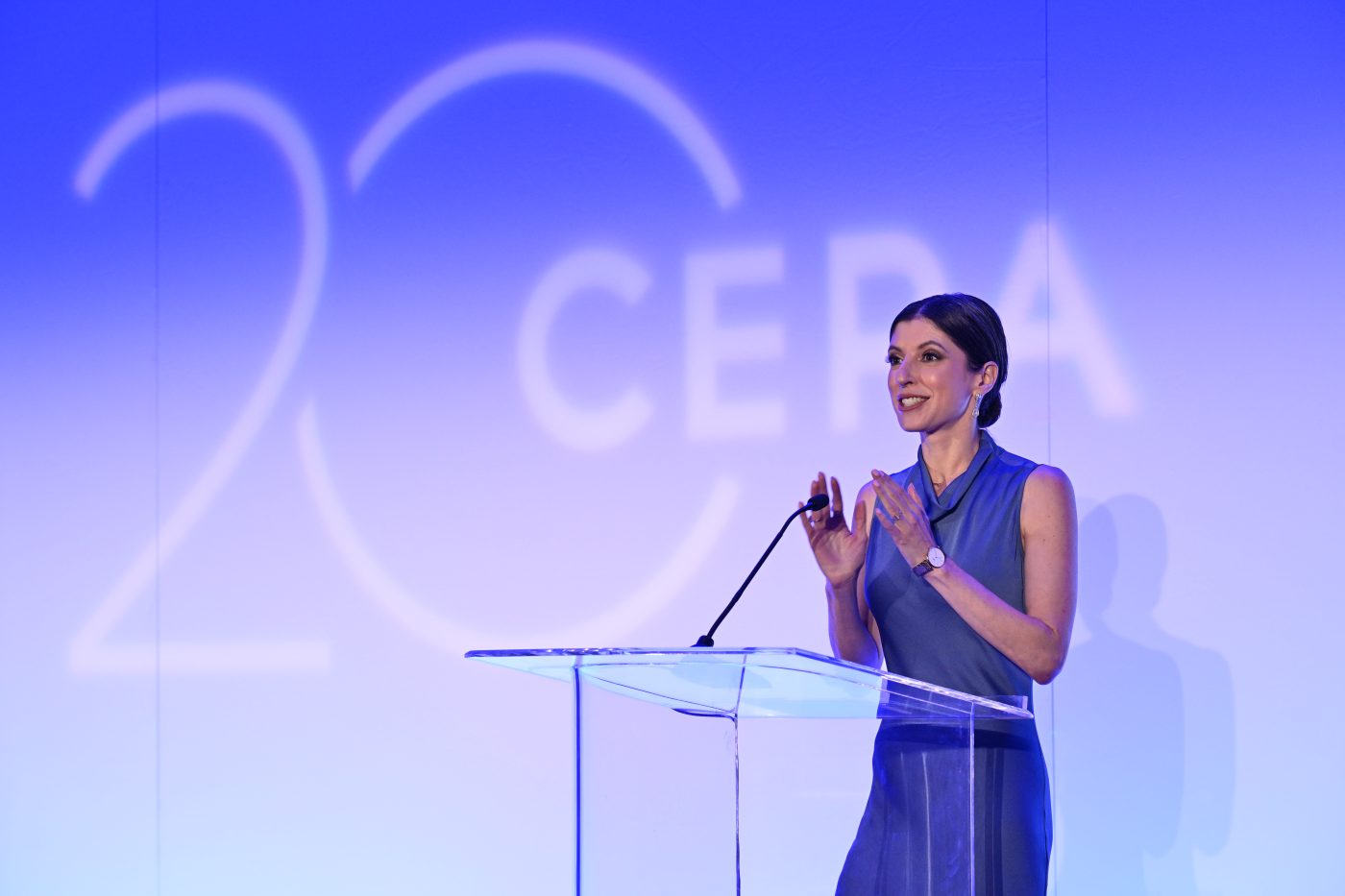
Founded in the days when it was seen as counterintuitive to set up a think tank focused on Europe and security, the Center for European Policy Analysis (CEPA) has become ever more vital since its outlines were sketched on a cocktail napkin by Larry Hirsch and Wess Mitchell in 2005.
One of the “core convictions” the two men began with was that “Central and Eastern Europe matters strategically to the United States,” Mitchell told a CEPA awards dinner in Washington. It was a view that clashed with conventional wisdom in the early years of the millennium, he said.

“In 2005, all eyes were on the Middle East,” he recalled. “Larry and I saw a lack of focus on Central and Eastern Europe and wanted to fill the void, not for reasons of nostalgia or for the cause of Atlanticism in the abstract, but because we believed that what happens in the lands between Germany and Russia is of profound importance to the American national interest.”
The two men wanted the new think tank to provide analytical depth and rigor, and to look beyond “breezy commentary” for long-term trends, he said. This meant they found themselves out on a limb but often ahead of their time.
“When we warned that Vladimir Putin was serious, that he was rearming, that he intended to conquer his neighbors, including Ukraine, and that NATO needed to urgently fortify its eastern frontier, a lot of people scoffed,” Mitchell told the audience. “Three wars and half a million casualties later, our warnings have been sadly validated.”
Bradford Hirsch, son of co-founder and CEPA chairman Larry, said his father had shared Mitchell’s vision that Central and Eastern Europe would be vital to the security of the US and Western Europe.
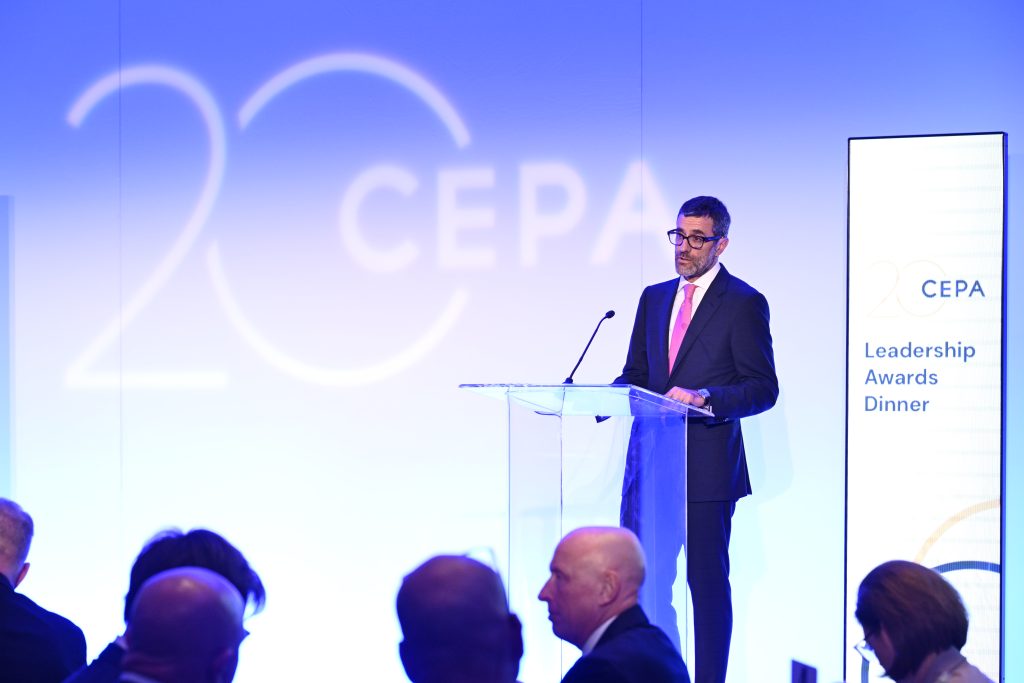
“There was no one explaining this to key stakeholders in Washington, DC, so he started CEPA,” Hirsch said. “To honor the hard-fought lessons of 1989 and carry forward the enduring mission of freedom, liberty, and security on both sides of the Atlantic.”
That vision, and the need for an institution to make the case to people in government, has been vindicated, he said.
“Central Europe and Eastern Europe are not just part of Europe’s story, they are the future of Europe in defense, in security, and in broader leadership,” Hirsch told attendees at the October 8 awards dinner in Washington. “And CEPA has been there every step of the way, serving as a bridge that strengthens the fabric of the Transatlantic union and alliance and nurturing the next generation of leaders to carry the torch of freedom forward.”
Former CEPA fellows have become government leaders across Europe, and the think tank has become a driving force behind policy, he said.
“Russia’s brutal war against Ukraine was a pivotal moment around the world, as it was for CEPA,” Hirsch told the audience. “It brought crystal clear focus as to why the NATO alliance, and Ukraine’s role within it, is the foundation of international security.”
Alina Polyakova, president and CEO of CEPA, said when the think tank was founded, people thought Europe’s security was settled and wouldn’t need to be thought about again.
“Europe was stable and boring, that’s what a friend of mine told me back then,” she said. “The idea of establishing a new institution focusing on European security was not only counter-intuitive, I think some may have even thought it was a little crazy. The word I would use is visionary.”
CEPA has been consistently ahead of the curve and identified arenas of competition and conflict, from the Black Sea to the Baltic and in the Arctic and across Europe, before others were aware of the risks, she said.
“Russia’s full-scale invasion of Ukraine focused not just CEPA, but the entire world, on how fragile our collective security actually is and how regional conflicts are now increasingly global,” Polyakova told the audience. “Everything is interconnected, and the outcome of Russia’s war against Ukraine will certainly determine Beijing’s designs on the Indo-Pacific and far beyond.”
The war in Ukraine also highlighted the opportunities for innovation and technology, areas where CEPA had already started focusing its research. The organization’s defense tech initiative, for example, was highlighting drones in 2020 “when very few were paying attention,” Polyakova said. Digital innovation and technology policy is now CEPA’s fastest-growing body of work.
“The intersection of tech and security now animates everything that we do at CEPA, because tech companies are now defense companies, and defense firms are now tech firms,” she said. “In the race for tech innovation, our greatest advantage over China is our allies.”
Thomas Penny is an editor and writer based in London. He has worked for local, national, and international news organizations, including the Mail on Sunday, the Daily Telegraph, Bloomberg News, and CEPA, and is now a freelance specializing in international relations, politics, and conflict.
Europe’s Edge is CEPA’s online journal covering critical topics on the foreign policy docket across Europe and North America. All opinions expressed on Europe’s Edge are those of the author alone and may not represent those of the institutions they represent or the Center for European Policy Analysis. CEPA maintains a strict intellectual independence policy across all its projects and publications.

War Without End
Russia’s Shadow Warfare

CEPA Forum 2025
Explore CEPA’s flagship event.