Combined with winter strikes on energy infrastructure, Russia’s campaign of destruction is degrading essential care for the most vulnerable and increasing preventable illness and mortality. The results are miserable, but there is no sign so far that Putin’s inhumanity is lowering Ukrainian morale.
The attacks are proof that, far from looking for peace, Vladimir Putin is trying to break Ukraine and achieve his aims by killing more non-combatants. Assaults on energy infrastructure and medical facilities during the coldest season are simply an attempt at mass murder — on January 20, more than a million Kyiv residents lacked heat and power as temperatures fell to –20C (–4F). Many others also lost water supplies.
With average temperatures well below zero, every outage is a health risk. They interrupt surgeries, disable diagnostic equipment, shut down hospital water supplies, and compromise life-support systems.
Since February 2022, Russia has treated hospitals, ambulances, medicines, and energy supply as legitimate military targets rather than protected civilian infrastructure. The scale of Moscow’s attacks is without precedent in modern Europe.
The raids target all of Ukraine’s biggest population centers. The hardest-hit regions include Kyiv and the surrounding oblast, as well as Kharkiv, Odesa, Dnipro, Sumy, Mykolaiv, and Chernihiv. The resultant cuts to vital services often last for days, putting the elderly, young children, and the vulnerable at extreme risk.
By December, the World Health Organization had verified 2,763 attacks on health care facilities in Ukraine since the start of Russia’s full‑scale invasion, killing 224 health workers and patients and injuring 896 more. A December strike on a maternity ward in Kherson, which damaged infrastructure and equipment as temperatures dropped, was part of a recent escalation.
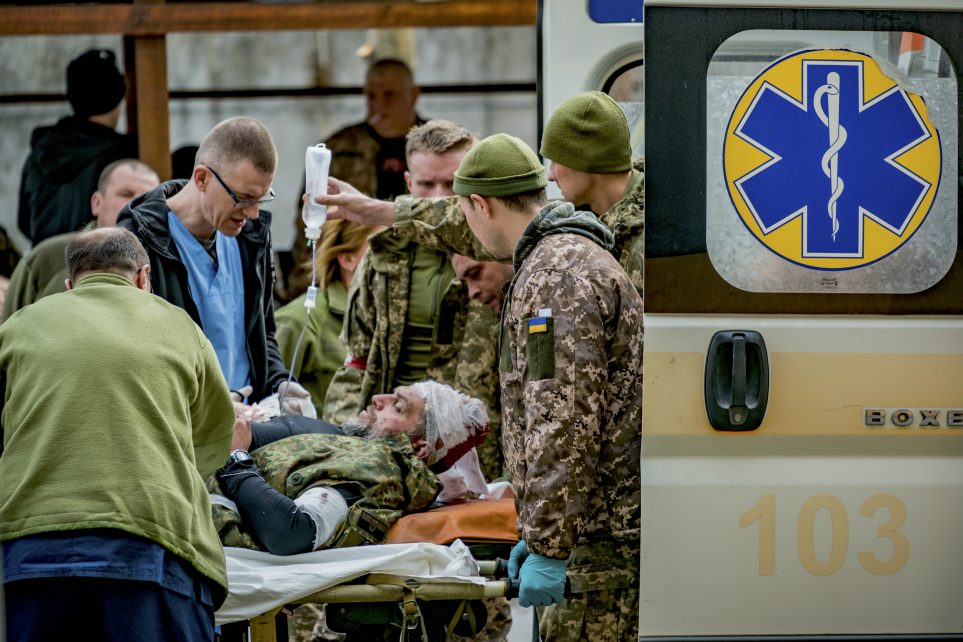
First responders have also been targeted, with around 200 ambulances damaged or destroyed per year, and medical transport workers face casualty rates several times higher than other healthcare staff. A hallmark of Russia’s brutality is the “double tap,” a tactic it developed in Syria, where a location is struck to allow first responders and medics to arrive, and then struck again to kill them.
Since late last year, Russia has expanded its attacks on healthcare facilities into a more explicit war on medicine. Missiles and drones have struck Ukraine’s largest pharmaceutical warehouses, destroying centralized stocks that supply thousands of pharmacies nationwide.
In October, a missile attack on a warehouse belonging to Optima-Pharm, one of the largest pharmaceutical distributors, caused damage exceeding $100m and wiped out roughly 20% percent of Ukraine’s monthly medicine reserves. It was one of three deliberate attacks on the company’s warehouses in different locations.
A drone strike obliterated the main warehouse of the Med-Service pharmacy chain in December, cutting supplies to 500 pharmacies. Other major distributors, including BaDM, have suffered repeated losses to their logistics hubs.
Targeting pharmaceutical warehouses is strategically distinct from striking individual hospitals. The destruction of wholesale distribution centers forces nationwide shortages, drives price spikes, delays hospital deliveries, and interrupts treatment for chronic conditions ranging from diabetes to cancer.
Rebuilding modern pharmaceutical logistics facilities requires tens of millions of dollars and, critically, time — time during which patients are left without reliable access to essential medicines. The effect is cumulative, slow, and devastating.
And the human consequences are measurable. Ukrainians have reported reduced availability of medical services in WHO surveys, with a quarter saying they had lost access between the full-scale invasion and February 2025.
More than a third postponed care because they couldn’t afford medicines or treatment, while nearly 70% said their health had deteriorated compared to pre-war conditions, with particular spikes in mental health and neurological disorders.
At the same time, Ukraine is facing a serious disruption in vaccination coverage. Many immunization programs relied on billions in USAID funding and organizational support, which has been ended by the US administration, and several vaccines are no longer available in sufficient quantities. The seasonal influenza vaccination campaign, among others, failed because there weren’t adequate supplies.
In the occupied territories, the assault on health care is explicitly coercive. Russian authorities have detained and threatened medical workers, converted hospitals into military facilities, and made access to treatment conditional on patients having Russian passports. This “passportization” weaponizes care, turning hospitals into tools of political control and violating core principles of medical neutrality and international humanitarian law.
Despite these pressures, Ukraine’s health system continues to function in government-controlled areas through extraordinary effort. Ukrainian authorities, medical workers, and international partners have kept services running under conditions that would have collapsed most systems.
But resilience should not be mistaken for sustainability. The systematic nature of Russia’s attacks makes it clear that the objective is not incidental damage but the gradual dismantling of Ukraine’s capacity to heal its population.
At the same time, Moscow is attempting to bomb Ukrainians into the Stone Age by attacking modern basic conveniences, including electricity, water, and heat, and cutting access to them for more and more civilians across the country.
If it fails to support Ukraine and help with its air defenses, Europe may face a new wave of migration, as Ukrainians flee to the safety of neighboring countries. Help can’t come soon enough.
Elena Davlikanova is a Democracy Fellow with the Center for European Policy Analysis (CEPA). Her work is focused on Ukraine and Russia’s domestic issues and their effects on global peace. She is an experienced researcher who, in 2022, conducted the studies ‘The Work of the Ukrainian Parliament in Wartime’ and ‘The War of Narratives: The Image of Ukraine in Media.’
Lesia Orobets is a Ukrainian social activist, former politician, and diplomat. As an MP, from 2008 to 2010, she co-authored an educational reform bill and anticorruption laws. In 2012-2014, she served as a member of the Parliamentary Assembly of the Council of Europe and as the Secretary to the Parliamentary Committee for Foreign Affairs. Orobets supported the Revolution of Dignity (Maidan 2013-14). The mother of two daughters, her husband serves as a frontline Ukrainian Army officer.
Europe’s Edge is CEPA’s online journal covering critical topics on the foreign policy docket across Europe and North America. All opinions expressed on Europe’s Edge are those of the author alone and may not represent those of the institutions they represent or the Center for European Policy Analysis. CEPA maintains a strict intellectual independence policy across all its projects and publications.

War Without End
Russia’s Shadow Warfare

CEPA Forum 2025
Explore CEPA’s flagship event.