The US strikes on Iran have triggered another jarring lurch of the Russian propaganda seesaw, whose ups and downs have characterized Kremlin propaganda under the presidency of Donald J. Trump.
On one hand, government figures and state propagandists are thrilled that Ukraine is being pushed to the back burner of US foreign policy. On the other, they are far less enthusiastic with Trump’s approach towards their ally Iran, even if Putin has made clear that the mullahs will receive no direct aid.
Trying to play all sides is a balancing act, and the Kremlin’s talking heads do their best to walk the swaying tightrope of state-controlled messaging.
Shortly after the strikes, Kristina Busarova and Roman Guz, hosts of the morning show At Dawn on the Solovyov Live channel, immediately drew parallels between Trump and Adolf Hitler, by pointing out that he scheduled the operation for the early morning of June 22, the anniversary of Operation Barbarossa when Nazi Germany attacked the USSR in 1941. The date has no historical resonance in the United States.
In the slightly predictable albeit zany world of regime talking heads, Busarova hinted that the US was engaged in a conspiracy of some sort: “Perhaps there is something to it and it’s not just a coincidence,” she said, without elaborating.
Guz proceeded to compare Trump’s post-strike statement to Hitler’s speech justifying Germany’s invasion of the Soviet Union, claiming to have found uncanny similarities. He quoted Hitler’s proclamation, where he said: “At this moment, an attack unprecedented in the history of the world in its extent and size has begun.” The presenter juxtaposed this to Trump’s statement, which said “this is a historic moment for the United States of America, Israel, and the world.” Guz said, “Both of them claimed to be doing this for the sake of the world.”
Such parallels were drawn by numerous hosts and pundits, which likely signifies that the topic was on the list of talking points that are commonly disseminated to Russian media organizations by their government overseers. Not everyone stuck to the script however. Appearing on Sunday Evening With Vladimir Solovyov, Andrey Sidorov, Deputy Dean of world politics at Moscow State University, dismissed the thought that Trump intentionally chose the infamous date. He instead accused the US president of ignorance. “As far as what happened today, I don’t think Trump ever read a single book about World War II,” he said.
Before the strikes took place on June 21, Russian state television had been setting the stage to show that the Kremlin was attuned to Trump’s policies. Military experts and international affairs specialists made rounds on Moscow’s most popular talk shows, explaining that US strikes on Iran were all but inevitable. On June 23, Kremlin spokesman Dmitry Peskov said: “The topic of Iran itself was repeatedly discussed by the presidents during their most recent conversations.”
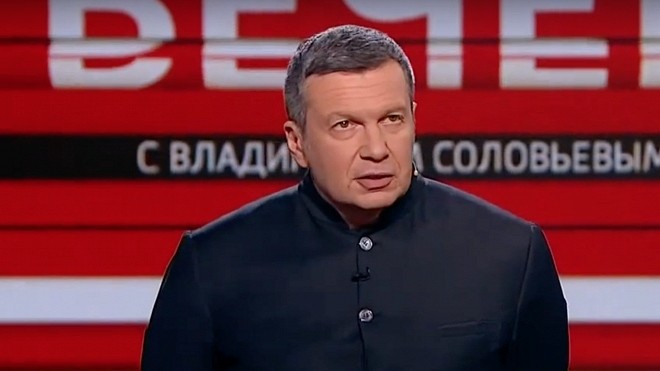
Last week, during his show The Evening With Vladimir Solovyov, leading propagandist and TV host Vladimir Solovyov not only asserted Trump would strike Iran but even predicted that he would eventually resort to nuclear weapons. After the attacks, Solovyov was even more adamant that after Iran retaliates, the US president will amp up his approach and employ nukes. Russian experts rub their hands at the thought since in their view this would clear the way to Kremlin use of nuclear strikes to break the deadlock in Ukraine.
Military expert Evgeny Buzhinsky pointed out that Iran’s retaliation might eventually become nuclear. He said: “From my point of view, they have every opportunity to create a nuclear warhead.” When other pundits questioned where this weapon would undergo its testing, Solovyov suggested they might skip this step and immediately use it for a strike. Laughing, Buzhinsky concurred: “Yes, they might hit Israel with it.”
Semyon Bagdasarov, Director of the Center for the Study of the Middle East and Central Asia, pointed out that the current regime is relatively safe, because the United States “doesn’t have an army of 500,000 or a 1 million to occupy Iran.” He asserted that whenever things stabilize, Iran might develop a nuclear weapon. He added: “It’s pointless to deny this.”
Solovyov repeatedly condemned America’s “unjustified” attacks on Iran, but at the same time stressed that if Ukraine moves to develop a nuclear bomb, “There will be catastrophic consequences. Ukraine will cease to exist. It’s not needed even now. Everything that is ours is necessary, but everything that is theirs isn’t.”
Another bonus for Russia is the anticipation of rising oil prices (even though market reaction has so far been muted). Solovyov relished the thought: “This means crazy price increases for everyone. For us, it will be beneficial. The price of oil will skyrocket, which is good for us.”
The self-interested regime analysis shot through most of the propagandists’ utterances. During his Sunday show on June 22, Solovyov asserted: “We need to move on to a very proactive political game. The time for this is ideal — simply ideal.”
He called on Moscow to form military alliances with other countries and stated: “It’s clear that a big world war is inevitable. The way it’s spiraling right now makes it certain that the whole world will be engulfed.” Solovyov also succumbed to the temptation to have a shot at the United States, Russia’s traditional enemy, as he scoffed: “If [Iran] strikes a base, then this was its fate. Americans will certainly meet those coffins in a beautiful way. Americans know how to organize beautiful burials.”
In public at least, Putin was happy to offer words of support to the Iranian theocracy. He hosted Iran’s foreign minister Abbas Araqchi in Moscow on June 22 and told him there was no justification for the US bombing of his country.
He assured Araqchi that Russia was trying to help the Iranian people, without making any detailed promises. In the run-up to the strikes, military experts were keen to point out that the Russia-Iran strategic partnership pact, only signed in January, did not include a mutual defense clause.
Appearing on the show The Right To Know, Chairman of the Council on Foreign and Defense Policy Fyodor Lukyanov shared that Russia’s partners in the Middle East are closely watching whether Moscow will extend a helping hand to Iran, after it proactively boosted Putin’s invasion by supplying Shahed drones and other weaponry.
In which case they will take note that in Iran — and recently in Syria — Russia has been no more than an onlooker. Laying the groundwork for Russia’s stance as noncommittal, state TV shows repeatedly shifted the blame onto its “no limits” ally in China for failing to protect Iran.
Appearing on Russia’s 60 Minutes, military expert Igor Korotchenko stressed that China should do the heavy lifting to help Iran, because Russia is already busy in Ukraine, “fighting the collective West.”
Julia Davis is a columnist for The Daily Beast and the creator of the Russian Media Monitor. She is a member of the Academy of Television Arts and Sciences, the Screen Actors Guild, and Women In Film.
Europe’s Edge is CEPA’s online journal covering critical topics on the foreign policy docket across Europe and North America. All opinions expressed on Europe’s Edge are those of the author alone and may not represent those of the institutions they represent or the Center for European Policy Analysis. CEPA maintains a strict intellectual independence policy across all its projects and publications.

War Without End
Russia’s Shadow Warfare

CEPA Forum 2025
Explore CEPA’s flagship event.