“It was the worst night of my life. My soul was ripped out, my heart was ripped out,” said Oksana Stasik, principal of the only school in the village of Vozdvizhivka, Zaporizhzhia Oblast, as she remembered the night in October 2022 when it was destroyed.
“There were four strikes,” she said. “I don’t know what, but it was something powerful, because the craters in the park were about 5 meters [16ft] deep.”
Before the full-scale invasion, more than 100 students attended the school, and 17 teachers were employed there, she said. It is one of more than 3,500 that have been affected by the war, with nearly 400 completely destroyed, according to Ukraine’s Ministry of Education.
In areas occupied by the invaders, schools and kindergartens have been used as military encampments, vehicle parks, medical facilities, and even as prisons, according to a report by Human Rights Watch. Moscow’s forces looted computers, TVs, electronic whiteboards, and heating systems, thefts that the report described as war crimes.
“Russia is systematically and continuously attacking Ukraine’s education system,” said Anna Novosad, a former education minister and co-founder of savEd, a foundation working to restore access to learning. “It’s part of their long-term strategy to eliminate anything Ukrainian. Education plays a key role in building identity and culture. They know exactly what they’re doing.”
While all Ukrainian children face common challenges — daily shelling, air raid sirens, a lack of sleep, and disrupted learning — some regions are dealing with even more severe issues, she said.

“The gap between a typical child in school in Kyiv and one from a village in Kherson region, for example, has now reached nearly five academic years,” she said. “And when you look at the map of the front lines and liberated areas, most of these places are small villages or towns, so they suffer even more.”
Children in Ukraine’s frontline cities have spent between 3,000 and 5,000 hours — up to seven months — sheltering in basements and metro stations over the past two years, according to UNICEF, the United Nations children’s agency. About a million out of four million schoolchildren are now studying entirely online, with some using a blended learning approach. Last academic year, that number was nearly 1.8 million.
“In many regions, there’s a situation where an entire generation of primary school-age children has never attended school,” Novosad said. “They missed a critical, age-sensitive phase of learning that’s difficult to make up for, especially because it’s so tied to their development — skills like communication and understanding their place in the world.”
The 1.6 million Ukrainian children in the occupied territories have to attend Russian-controlled schools and follow the invaders’ curriculum. If they want to stay connected with Ukrainian education, they have to study online, with afternoon lessons from Tuesday to Saturday.
“We don’t set deadlines for students to complete assignments because we understand that the connection in temporarily occupied territories isn’t always stable,” one educator told the New Ukrainian School website. “We’ve also introduced asynchronous learning, allowing children to complete tasks at their convenience.”
For safety reasons, students log in with their cameras off and use pseudonyms known only to their teachers.
In Ukrainian-controlled territory, many cities have found their own solutions to keep education going. In Zaporizhzhia, for example, where classes are currently online, construction has begun on 12 bomb and radiation-proof underground schools to accommodate 12,000 students.
In Kharkiv, many schools have already moved underground to protect children from Russian attacks. More than 6,000 children are currently studying in these subterranean classrooms and in metro stations.
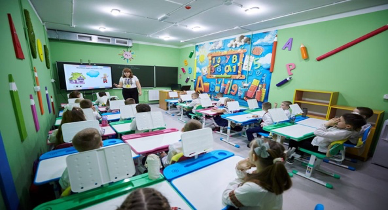
“Children who are finishing primary school are studying, but this is the first time they’ve seen each other in person,” said Kharkiv Mayor Ihor Terekhov. “COVID and the war have taken away their opportunity for a normal education.”
Anna Novosad says bringing education back to the regions isn’t just about classrooms, it’s also about giving families a reason to stay in their homes.

In Bohdanivka, Kyiv region, the local school was occupied by Russian forces and burned down during their retreat. In July 2024, the savED Foundation, in partnership with Washington-based nonprofit IREX and USAID, opened Ukraine’s first Transitional Learning Center in the village, with space for 250 students.
“Families who were moving to other villages or Kyiv are staying because the school is now open,” Novosad said. “Before, they had no choice but to leave. For many, the availability of educational services is a key factor in deciding whether to stay or return to their communities.”
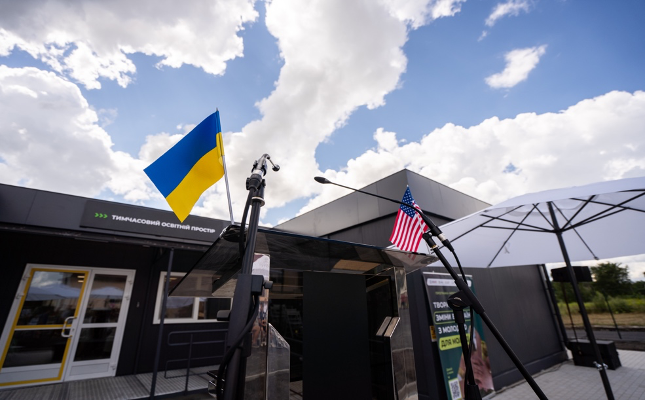
SavEd has been forced to pause two projects due to the suspension of USAID funding, including the creation of Transitional Learning Centers where schools were destroyed by Russian forces. The charity is continuing its other work and plans to restore support for tutors in frontline communities.
Each day without education adds to the cost of recovery, Novosad said. If the war drags on for another year, there will need to be real solutions for the children and teachers in the hardest-hit regions, such as Kharkiv and Zaporizhzhia, she said.

In one innovative plan, the Ministry of Education is developing an exchange program to take children from Zaporizhzhia and Kharkiv, where they are stuck in online learning, to schools in Lviv for in-person classes.
“If we host kids and families and let them go to the local schools and socialize them a little bit. It will make a difference,” Novosad said. “If the war continues, we’ll need more than just handing out tablets for online learning in Kharkiv. We need creative solutions to ensure these kids aren’t left behind.”
Elina Beketova is a Democracy Fellow at the Center for European Policy Analysis, focusing on the occupied territories of Ukraine. She worked as a journalist, editor, and TV anchor for various news stations in Kharkiv and Kyiv.
Julia Beck is a Communications Intern at the Center for European Policy Analysis (September-December 2024) and a graduate student studying International Affairs at George Washington University.
Europe’s Edge is CEPA’s online journal covering critical topics on the foreign policy docket across Europe and North America. All opinions expressed on Europe’s Edge are those of the author alone and may not represent those of the institutions they represent or the Center for European Policy Analysis. CEPA maintains a strict intellectual independence policy across all its projects and publications.

War Without End
Russia’s Shadow Warfare

CEPA Forum 2025
Explore CEPA’s flagship event.