At great cost, in tight secrecy and with considerable risk, Russia is developing a nuclear-powered missile. Given NATO’s flimsy air defences, the latest test flight (reported but not confirmed) of the Burevestnik is certainly noteworthy. Countering a conventionally-powered missile is hard enough. If downing the intruder risks showering your country with nuclear waste, the stakes are even higher.
But another threat is far more pressing. For a tiny cost, with minimal secrecy and risk, Russia seems to have found an effective new weapon: balloons. These involve no high technology and carry no significant payload. Their normal use is for smuggling. With the right wind, they float cigarettes effortlessly and profitably across the Lithuanian border from Belarus. The only technological trick is ensuring that they crash-land in a suitable location, and can be found by the smugglers’ accomplices.
Using these balloons as weapons is even easier. They carry nothing, and nobody cares where they land eventually. Their only mission is to drift near an airport—and by their mere presence, close it. The decision is automatic: risk-aversion is embedded in modern aviation, not just out of respect for human life and valuable property, but because of the colossal insurance liabilities involved in knowingly breaching a safety protocol.
For a modern economy, airport closures mean huge inconvenience (just ask the Ukrainians, who have had no civil aviation since 2022). And the reputational damage is even worse. If a country is not safe to fly to, it is probably not safe to lend to, to invest in, to trade with, or to visit. For a cost of perhaps €100 each, balloons can cause untold economic harm, reflected in higher borrowing costs and cancelled deals.
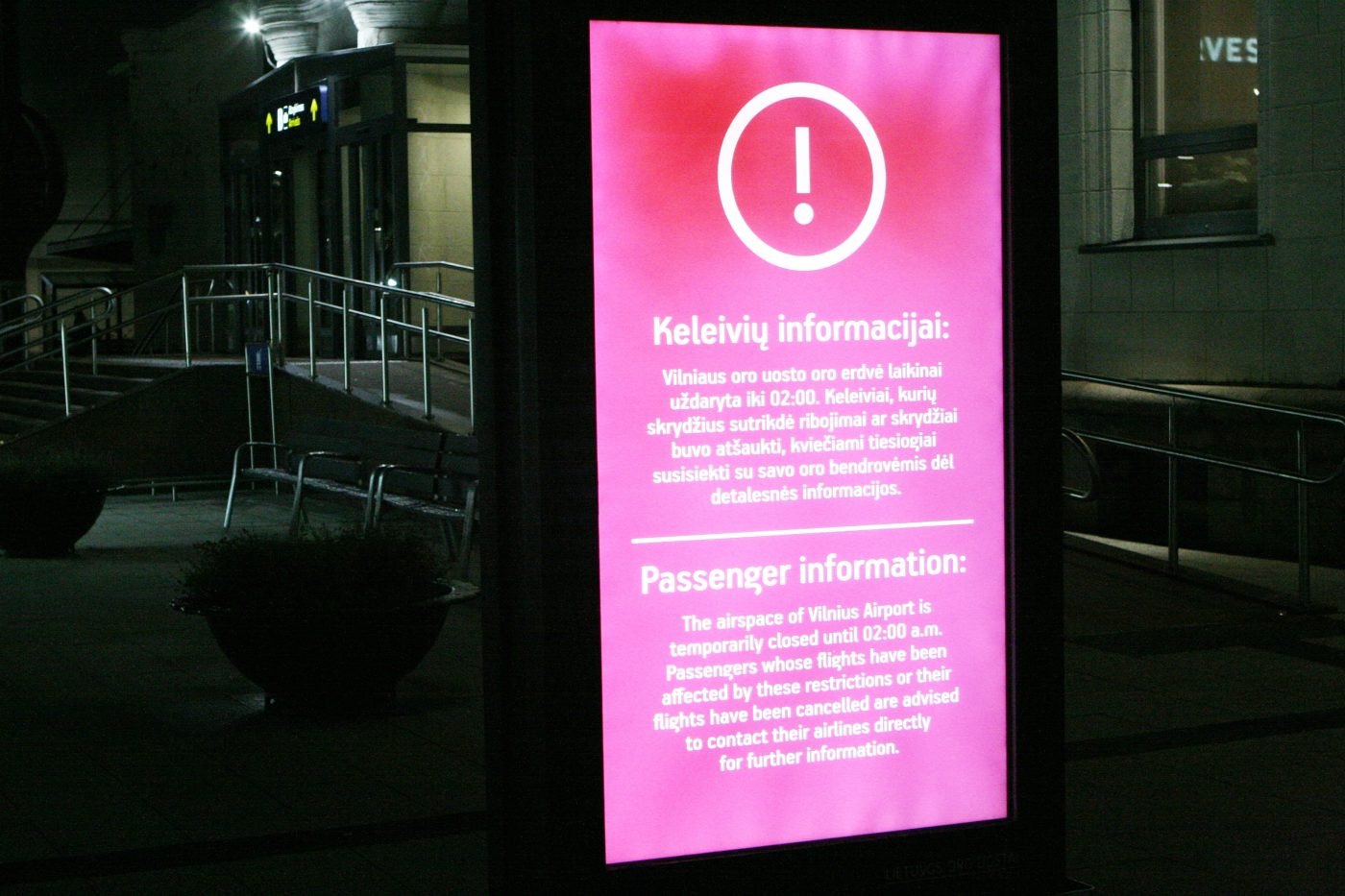
That is what Lithuania faces now. Balloons from Belarus disrupted flights on two successive nights last week, leading to fourteen flight cancellations and seven diversions. Other instances were recorded earlier in the month. Officials are not yet blaming Russia or describing the flights as an act of “hybrid warfare”. These balloons could (just possibly, perhaps, maybe) be part of some intense but incompetent smuggling operation.
But it would be a big mistake to see this episode as a local problem, or a trivial one, or a one-off. Every European airport is vulnerable to this kind of attack. And the target is not Lithuanian aviation. It is NATO’s credibility. The Kremlin is systematically testing our decision-making, just as it has done in previous months with attacks on the sub-sea cables and pipes in the Baltic Sea, on energy and communication infrastructure in Sweden, and with numerous drone flights and airspace intrusions. The questions are simple. How do NATO countries react to these attacks? Do they attribute them? Who responds and how?
The answers are bleak. Allies are leaving Lithuania to bear the burden of trying to deter Belarus by closing border crossings, while the United States, Europe’s supposed security hegemon, is flirting with the regime in Minsk. If NATO cannot stop joke-state Belarus from launching toy balloons, how is it to deter Kremlin decision-makers, as they tinker with their new, nuclear-powered toys?
NATO countries’ decision-makers still do not (to use European foreign-policy chief Kaja Kallas’s phrase) “join the dots”. In an excellent collection of essays published by Poland’s ABW security agency, Rafał Miętkiewicz of the Polish Naval Academy argues that the “creeping, staggered and difficult to immediately diagnose” threats in the Baltic Sea region require “far-reaching consolidation” of national and cross-border activities, with a new political emphasis on changing strategies, doctrines, laws, and institutions.
Quite right. But we see little sign of it. And we are already out of time.
Edward Lucas is a Senior Fellow and Senior Advisor at the Center for European Policy Analysis (CEPA). He was formerly a senior editor at The Economist. Lucas has covered Central and Eastern European affairs since 1986, writing, broadcasting, and speaking on the politics, economics, and security of the region.
Europe’s Edge is CEPA’s online journal covering critical topics on the foreign policy docket across Europe and North America. All opinions expressed on Europe’s Edge are those of the author alone and may not represent those of the institutions they represent or the Center for European Policy Analysis. CEPA maintains a strict intellectual independence policy across all its projects and publications.

War Without End
Russia’s Shadow Warfare

CEPA Forum 2025
Explore CEPA’s flagship event.