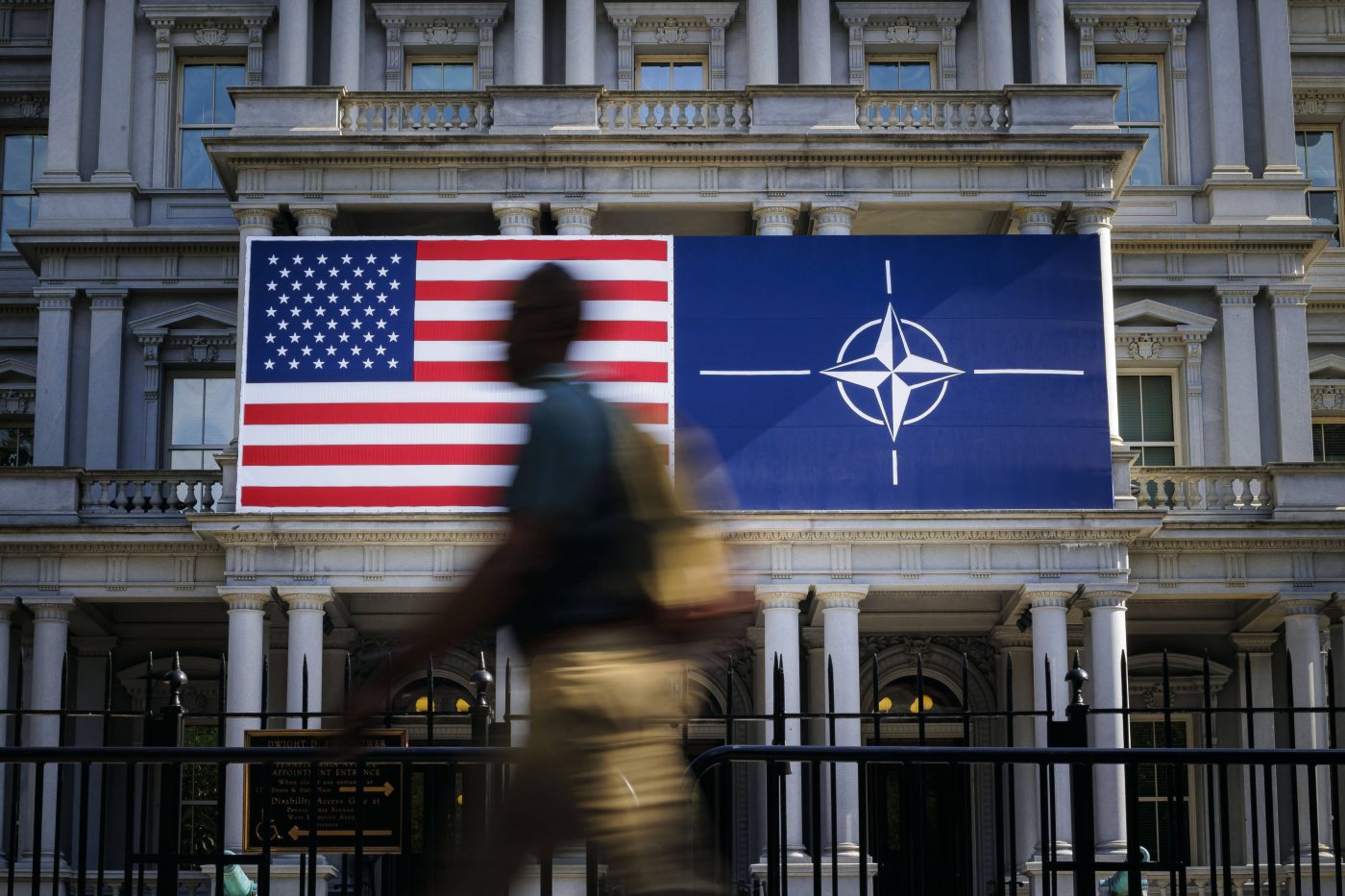
Just a year ago, polls showed the majority of Americans supported NATO. Even as the alliance celebrated its 75th anniversary in 2024, multiple surveys found strong sentiment among the American public for the US to stick with the alliance.
Now, America is at best an unenthusiastic member of NATO. At worst, the Trump administration could withdraw.
What changed?
The answer is not much. Donald Trump’s America is basically the same old America. And if Trump were to leave office tomorrow, NATO and Europe would still face a difficult but inescapable challenge: convincing the average American that they should care about the security of a continent more than 3,000 miles away.
It’s easy to pretend that the existential crisis of the Western bloc began with Trump. But Trump is actually no more than a catalyst for resentments and suspicions that have been lurking in the corners of American politics since NATO was formed in 1949.
The fact is that a sizeable minority of Americans are opposed to or lukewarm toward US participation in NATO. A February 2024 Gallup poll found that two-thirds of Americans wanted the US to maintain — or even increase — its role in NATO. An April 2024 Pew Research survey found 58% have a favorable view of NATO. Those polls aren’t much different than April 1948 – a year before the NATO treaty was signed – an early Gallup poll found 65% of Americans supported joining the alliance.
Yet consider the flip side of those numbers. In 1948, 21% of Americans opposed the creation of NATO. In 2024, 28% of Americans either wanted to reduce support for NATO or withdraw from the alliance entirely, according to Gallup, while Pew found that 38% have an unfavorable view of NATO. To be clear, the demographics have shifted somewhat: nearly as many Republicans as Democrats supported NATO in 1948, while three times as many Republicans as Democrats wanted to leave the alliance in the 2024 Gallup poll.
American politics has been transformed, but not because the average American suddenly hates NATO. What really changed is who controls the levers of power in Washington. During the Cold War and for decades afterward, NATO enjoyed a fairly bipartisan consensus among American politicians and political parties that the Western alliance was worth keeping. The isolationists were a minority — some would even have said extremist — faction.
But in November, US politics were turned upside down. It’s as if Philip Roth’s alternative history novel The Plot Against America — where the isolationist Charles Lindbergh becomes President in 1940 on the back of America First campaigning— has become closer to reality, something that must have Franklin Roosevelt and Winston Churchill spinning in their graves.
Nonetheless, Europe has to deal with America as it is, and not America as Europe wants. For the foreseeable future, European security will depend on US military power and the US defense industrial base. Somehow, NATO will have to reforge the bonds of old.
This requires recognizing the new realities. Foreign policy is not the biggest issue for the American people, compared to 1940 or 1968. What got Trump reelected wasn’t Ukraine or NATO, but the price of eggs more than doubling.
Nor will traditional appeals work, such as highlighting ethnic and historical ties between America and Europe, or pointing to shared values and interests. US demographics have changed: the percentage of Americans of European ancestry has declined from 90% in 1950 to 59% in 2020. The old foreign policy elites are being marginalized or vilified. The new elites on college campuses (or at least the most vocal among them) have little affection for the West in general.
NATO’s best bet may be to appeal directly to the American people, using the same tactics that worked for Trump (and seem to be working for Russian and Chinese propaganda). Social media has become the most powerful tool of political mobilization in the 21st Century. Indeed, a majority of new Trump voters in 2024 used social media as their primary source of news, which enabled the Trump campaign to bypass traditional outlets.
So if the isolationists and the alt-right can exploit social media, why can’t NATO? Why can’t there be a flood of podcasts, as well as YouTube, Instagram, and even TikTok videos, that are aimed at the average American? They could explain the dangers of Russian expansionism, why a secure Europe means a more secure America, and how their grandparents and great-grandparents saved the world from Fascism and Communism.
It won’t be easy. The danger of social media is that it’s much easier to spread simple propaganda (“NATO bad/Russia good”) than nuanced explanations of geopolitics. Nor can words replace deeds: Europe is going to have to spend more on its own defense from now on. And Europeans must remember that for 75 years, American troops and taxpayers have defended lands 3,000 miles from home.
Maybe America’s reasons weren’t always altruistic. But nowadays, a little gratitude can go a long way.
Michael Peck is a defense writer whose work has appeared in Business Insider, Forbes, Defense News, Foreign Policy magazine, and other publications. He holds an MA in political science from Rutgers Univ. Follow him on Twitter and LinkedIn.
Europe’s Edge is CEPA’s online journal covering critical topics on the foreign policy docket across Europe and North America. All opinions expressed on Europe’s Edge are those of the author alone and may not represent those of the institutions they represent or the Center for European Policy Analysis. CEPA maintains a strict intellectual independence policy across all its projects and publications.

War Without End
Russia’s Shadow Warfare

CEPA Forum 2025
Explore CEPA's flagship event.