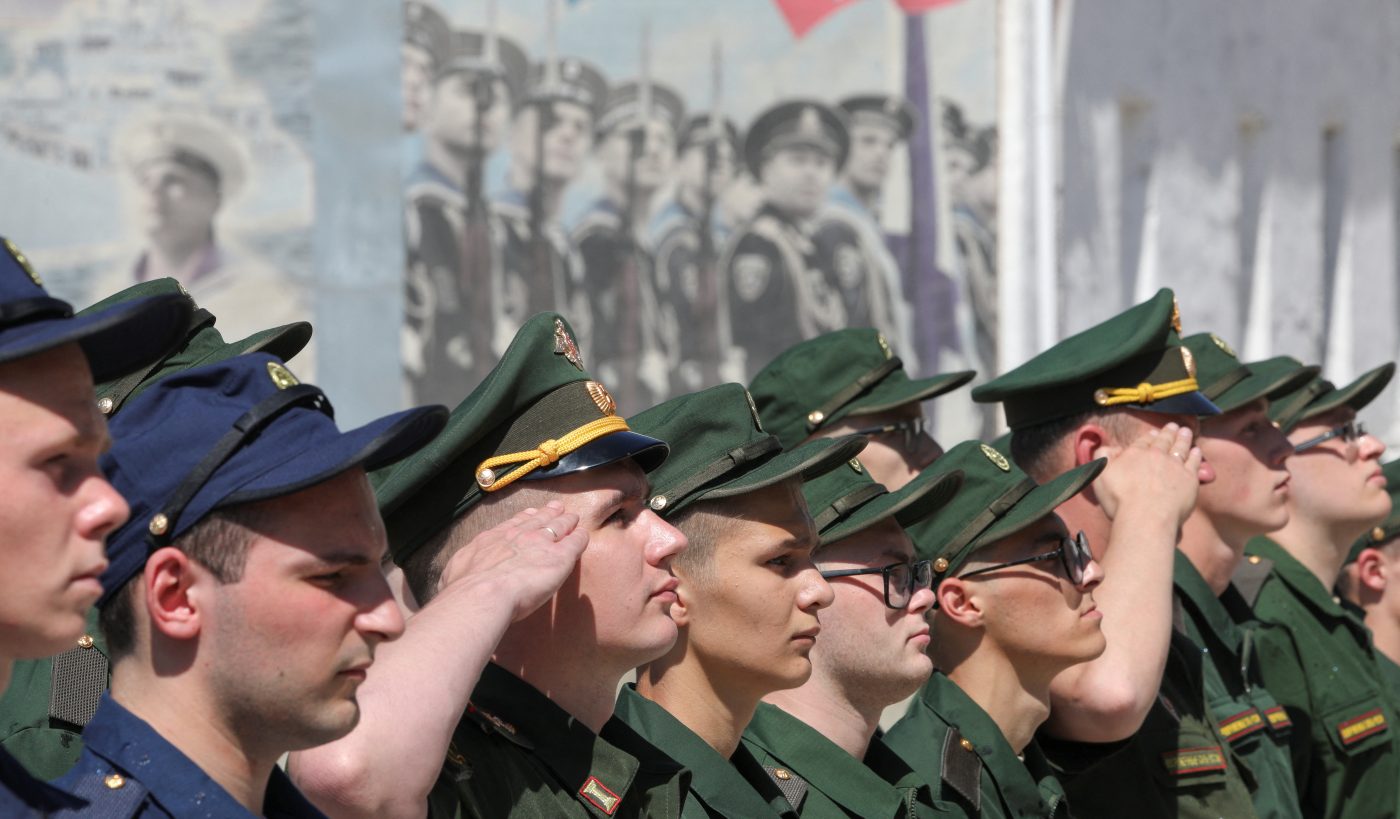
If Russia’s plan to decapitate the Ukrainian state had worked, the casualty-lite operation would probably have enshrined Putin in Russian history. Instead, it is bleeding the country of its most precious resource; its young people.
During the ultimately successful February assault on Avdiivka, Russia pressed forward in the style of the 1941-45 Great Patriotic War. Soldiers were scythed down by Ukrainian defenders in extraordinary numbers — British military intelligence estimated that throughout the month, losses in dead and wounded were running close to 1,000 a day.
This is not the Great Patriotic War and Russians do not see it as a conflict that their national survival depends on. Public opinion surveys by the Institute for Conflict Studies and Analysis of Russia (IKAR), which I head, offer a stark illustration of the deterioration in fighting sentiment among ordinary Russians. To be clear, this is not to say that outright revolt is brewing or that people want an end to the Kremlin’s war of aggression at any price. But it does show that while Russians are happy enough for others to fight, they are profoundly unwilling to go themselves.
Early last year, about 60% rejected a second wave of mass mobilization. That number had risen to 74% by the second anniversary of the invasion. At the same time, the number of supporters of the new wave of mobilization slumped — from 24% at the beginning of last year to 14% at the beginning of 2024. Those attitudes are even stronger among the young.
At a time when many in the West are focused on blockages to new aid for Ukraine (especially opposition from right-wingers in the US House of Representatives), our findings show there are also powerful countervailing forces that make the war’s prolongation harder for Russia.
The Kremlin’s argument that Russia is engaged in a Great Patriotic War 2.0 has failed, our results show. The population just does not accept it. Instead, they believe the war is extremely dangerous for participants and they are right — British intelligence also noted that the official number of disabled Russian males aged 31-59 increased by a record 507,000 in 2023, a leap of 30%, mostly due to the war.
These damaged men are a huge drain on the resources of the country’s health care and rehabilitation systems. But they are more than that. They are also witnesses and illustrations of what happens on the real front line, not the propaganda-heavy depictions fostered by the Kremlin and its mouthpieces.
It is perhaps unsurprising that the word is out and the response so stark. Young people aged 18-30 years are outright opposed to any suggestion they be sent to Ukraine. Even at the beginning of 2023, this age group clearly rejected opposition to the second wave of mass mobilization, with 74% against another round of mobilization (the first was in the fall of 2022.) A year later, the figure has reached 84%.
The reasons for the clear negative attitude towards a second wave of mobilization are obvious: young people are the first to be sent to the war and they, more often than other age groups, receive real information about what awaits them. After all, they have friends who have already been mobilized. On average, young people are twice as likely as their older fellow citizens to say that they have one or more friends among drafted Russians.
The second reason is closely related to the first: the rate of those who have had several friends killed in the war is almost double among young people as among all generations. Therefore, young people, more often than other age groups, not only receive information about the real course of events at the front from direct participants, but also more often than others have war dead among their inner circle. This is enough to make ardent would-be warriors more hesitant.
It should be emphasized that the rejection of mobilization and personal participation in the war is not driven by pacifist or other moral beliefs among the young. It is pragmatic — they don’t want to die or be maimed.
Such near-universal attitudes are a great danger for the Kremlin.
The most obvious policy response is to change the story. If the young won’t sacrifice themselves for the idea that, like their grandparents, they are fighting for Russia’s life as a nation (a theme still pushed by senior leaders) then how about the idea that Russia’s enemies are coming to kill and main inside the country?
This might change popular motivation from the pragmatic to the fearful. Self-preservation, as well as group solidarity, are strong human instincts.
It is not yet clear that the terrorist attack at Crocus City Hall on March 22 was deliberately allowed to occur, but is certainly a possibility. As the Washington Post reported on April 2, US intelligence specifically mentioned the Moscow concert venue in its warning of impending terrorist activity in Russia earlier in the month. Almost 300 people were killed and injured by Islamist terrorists at a site apparently devoid of security forces.
Russia unhesitatingly blamed Ukraine and later the US and UK, while offering no proof of such a convoluted plot (because it doesn’t exist.)
So why make the allegation? The answer may be that it’s a useful propaganda tool and feeds the idea that Russia is under attack. (Some also argue that such operations are in the regime’s DNA and point to the 1999 apartment bombings, which they blame on Putin.) The Crocus City attack has generated a huge wave of web browser searches, comparable only to Special Military Operation (SMO), which has been a meta-topic in Russian media since 2022.
The attacks and the imaginary Ukrainian link are useful to the authorities in several ways. Firstly, it drives home to Russians that the war can hit each and every one of them. Until now, only residents of the border areas — primarily the Belgorod region — have felt the war.
Secondly, it will justify mobilization in regions far from the center and in predominantly rural areas or small towns, as well as large conurbations where (the authorities will say), citizens are at risk. Thirdly, it helps to dehumanize Ukrainians and justify continuing war crimes against its people.
Whether or not the Crocus City attack was allowed to occur, it would not be sufficient on its own to justify the enormous Russian mobilization campaign that Ukraine’s President Volodymyr Zelenskyy has predicted will come in June.
The campaign will need to progressively displace the self-interest of young Russians and substitute it with the irrational motives of fear, anger, and revenge.
Every day now, the Russian authorities report new raids and arrests to prevent further supposed terrorist attacks. All of them were planned by Ukraine, according to state-controlled media.
Expect more to follow. Only through this shaping process will the Kremlin be able to move onto its ultimate goal; putting its young men in uniform and marching them toward Ukraine’s guns.
Dr. Oleksandr Shulga is the head of the Institute for Conflict Studies and Analysis of Russia (IKAR), the only institution in Ukraine conducting monthly sociological monitoring in Russia. He possesses 16 years of advanced experience in the field of quantitative and qualitative sociological research. During these years, has been a supervisor, consultant, and expert on a variety of projects, including areas of potentially escalating tension and instability.
Europe’s Edge is CEPA’s online journal covering critical topics on the foreign policy docket across Europe and North America. All opinions expressed on Europe’s Edge are those of the author alone and may not represent those of the institutions they represent or the Center for European Policy Analysis. CEPA maintains a strict intellectual independence policy across all its projects and publications.

War Without End
Russia’s Shadow Warfare

CEPA Forum 2025
Explore CEPA’s flagship event.