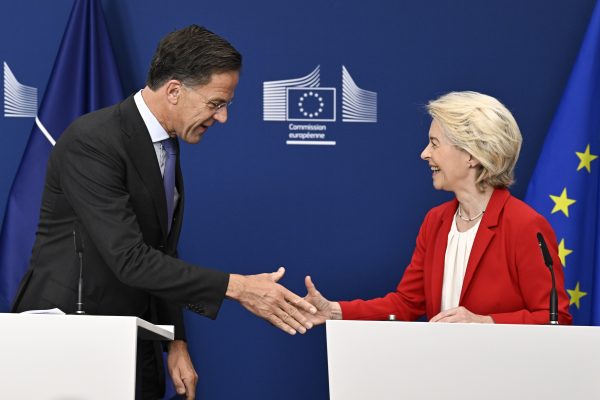
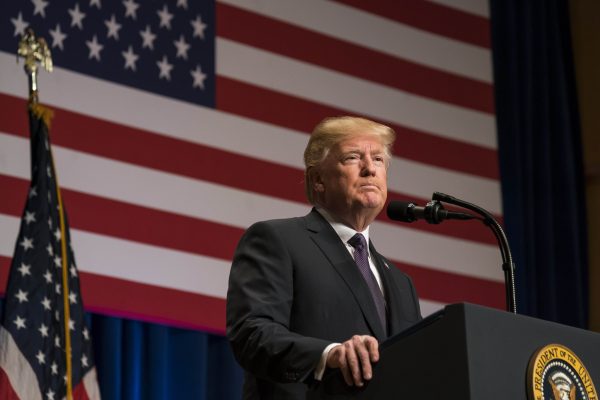
The recent decision taken at The Hague by European NATO allies to increase defense spending to 5% by 2035 has been justly celebrated as a step in the right direction. And though one can be skeptical whether the decade-long timeline will survive the test of political will, it nonetheless marked the recognition that rearmament is no longer a theoretical conversation while bringing the alliance closer to operationalizing NATO’s new regional plans.
The final communique — remarkably brief by past NATO standards — conveyed a sense of determination and purpose, giving the US administration and European governments a justifiable reason to call the summit a success.
While the meeting focused on Russia and European security, the new spending commitments cannot be considered separately from other theaters. The US and its European allies must now find a way to broaden the conversation so that European rearmament dovetails into the larger geostrategic environment the West faces.
For although all eyes were on the Atlantic theater at The Hague, democracies face a challenge to their security that is truly global in nature, as Russia, China, Iran, and North Korea work jointly to dismantle the security system America and its allies have built. The difference between preserving a modicum of systemic stability, and hence peace, and an all-out military confrontation will likely come down to four key regions: Europe, the Middle East, the Korean Peninsula, and the Indo-Pacific.
Two of these theaters have already been engulfed in war, while the remaining two are increasingly areas of concern, both due to North Korea’s aggressive nuclear and missile program and China’s massive military buildup, especially the expansion of the People’s Liberation Army Navy, which has surpassed the US Navy in fleet size.
In the years since the Obama administration first mooted the idea of a “pivot to Asia,” our strategic thought has become wedded to the notion that we can treat different theaters as self-contained areas of operation, compensating for inadequate resources with smart strategy and planning. If that is indeed the case, Europe should start thinking in terms of how it can help buttress America’s deterrence in the Indo-Pacific. It cannot simply say it plans to look after its own backyard.
This should be a priority for European capitals, for the US focus on the Asian theater is unlikely to diminish. While Russia’s revisionist aspirations pose a chronic threat to Europe and America’s interests on the continent, China’s push for regional hegemony in the Indo-Pacific and beyond poses a systemic threat to the United States and its allies.
That is why the decisions taken at The Hague give some reason for guarded optimism. The rearmament of European allies within NATO structures will reduce the cost of US security guarantees to Europe while shoring up the transatlantic alliance system. The pledges of investment by European NATO allies lay favorable foundations for strengthening the strategic linkages between the Atlantic and the Pacific theaters in US planning, creating in effect a degree of complementarity while maximizing the deterrent capabilities of America and its European allies.
It is therefore imperative that European rearmament be achieved in a way that integrates — rather than excludes — America’s defense industrial base in the effort and moves the Europeans and the Americans in lockstep when it comes to integrating command and control, information sharing, targeting, and developing and perfecting the battlefield management system.
Ultimately, the re-linking of the Atlantic and the Pacific theaters in US strategic thought will be achieved not through high-sounding declarations at government summit meetings, but through concrete decisions on weapons procurement and the fielding of ready military forces.
This process must serve as a reaffirmation of allied solidarity across both theaters. It should be driven by the rethinking of America’s force posture in Europe in close coordination with what the European allies can field and when.
Only then will planners be able to thread the needle of the joint effort to ensure that the security of the Atlantic and the Pacific remains a single, indivisible problem.
Chels Michta is a Non-resident Fellow with the Democratic Resilience Program at the Center for European Policy Analysis (CEPA). Chels is a former CEPA Title VIII Fellow and is currently a military intelligence officer serving in the US Army.
The opinions expressed here are those of the author and do not reflect the official policy or position of the Army, the US Department of Defense, or the US government.
Europe’s Edge is CEPA’s online journal covering critical topics on the foreign policy docket across Europe and North America. All opinions expressed on Europe’s Edge are those of the author alone and may not represent those of the institutions they represent or the Center for European Policy Analysis. CEPA maintains a strict intellectual independence policy across all its projects and publications.

War Without End
Russia’s Shadow Warfare

CEPA Forum 2025
Explore CEPA’s flagship event.