As European leaders plan to put thousands of ground troops into Ukraine as a deterrent force following a possible ceasefire, the question arises: where will these military boots come from?
British officials said on March 15 that a force of 30,000 would be assembled and that operational planning was now underway. Reports said the UK, France, Turkey, Australia and Canada would form the backbone of the deployment, and that others would help with logistics and other aid.
But Ukrainian President Volodymyr Zelenskyy has stated that a deterrent force would need to be 200,000-strong. And it’s clear manpower is seriously deficient in Europe. The entire French military only has 200,000 active-duty personnel, while the British army has fewer than 75,000.
Perhaps Zelenskyy felt like he had nothing to lose. If you’re going to demand help from European armies that don’t exist, why not ask for as many imaginary soldiers as you can? Because, despite the rhetoric, there are plenty of political and economic reasons to doubt that Europe will station troops in Ukraine.
Nonetheless, a deal without Western security guarantees for Ukraine is nothing more than a ceasefire. This would be a pantomime of peace where everyone knows how the story will end: either another Russian invasion, or a rump Ukrainian state withering under the permanent threat of invasion.
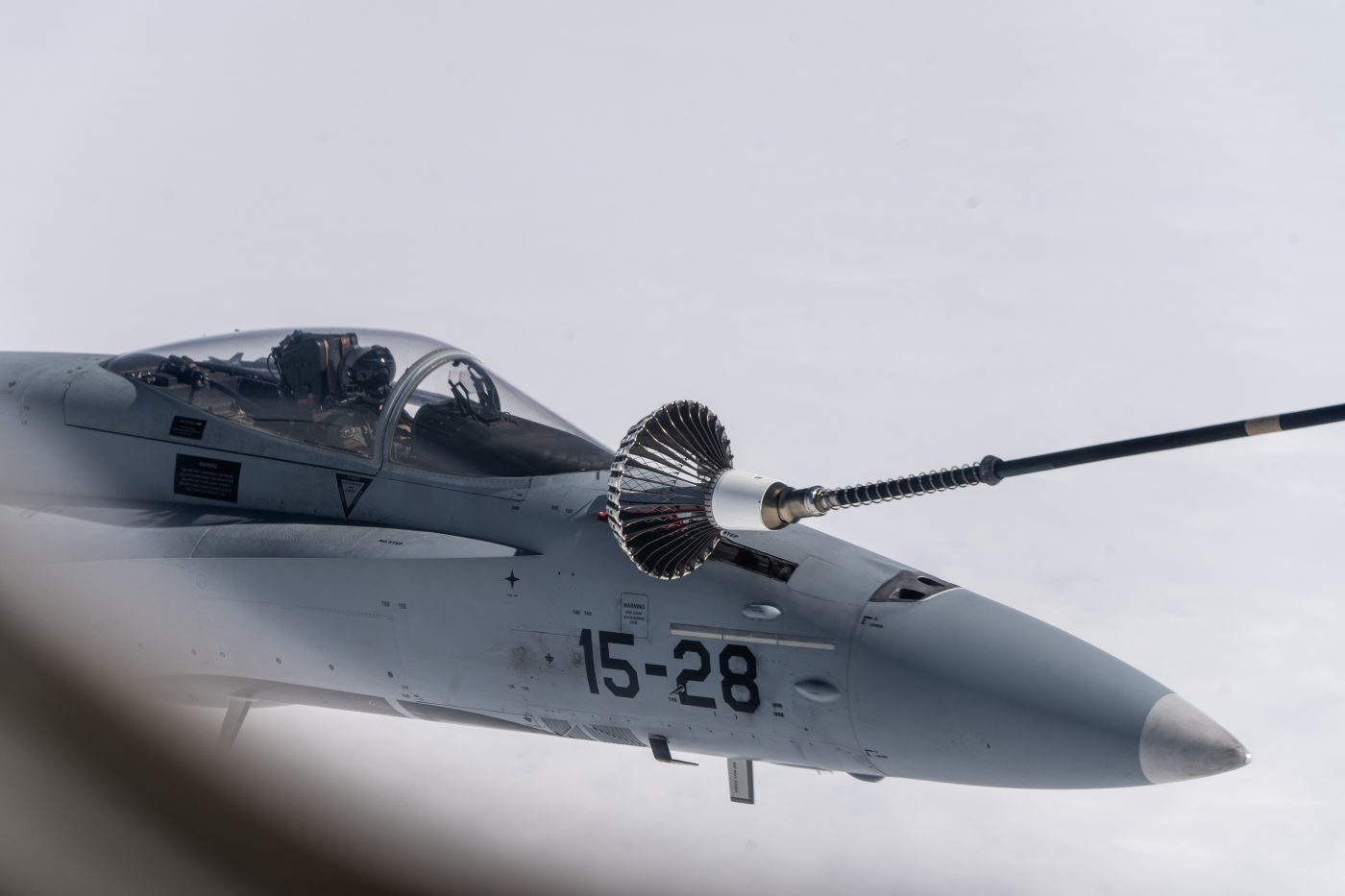
So if it can’t get foreign troops or join NATO, what can Ukraine realistically ask for? A group of European and American experts and politicians have a proposal: use European aircraft to defend Ukrainian skies. (The group includes the Center for European Policy Analysis, CEPA, Senior Fellow Edward Lucas.) The plan, called SkyShield, envisions an “Integrated Air Protection Zone.” Combat air patrols launched from European bases would protect “uncontested areas of Ukraine” — hundreds of kilometers behind the front lines — from Russian missile and drone attacks.
SkyShield would protect Ukrainian civilians and infrastructure, free up Ukrainian military resources, and send a signal to Russia,” argue the plan’s proponents. “By mobilizing just 120 European aircraft, SkyShield can achieve greater military, political, and socioeconomic impact than 10,000 European ground troops,” they wrote.
While Russia may try to stop the effort by using hybrid warfare tactics such as cyberattacks and propaganda, SkyShield’s backers are confident that Russia won’t directly fight European forces. “While the Coalition will need firm rules of engagement and must be ready for the possibility of engaging a Russian fighter jet . . . the escalatory potential of this moment is offset against the much higher escalation potential of not providing Ukraine with support.”
In many ways, SkyShield sounds similar to the NATO’s existing Baltic Air Policing Mission. Since 2004, NATO has rotated small numbers of fighters to airbases in Estonia and Lithuania, where they frequently scramble to intercept encroaching Russian aircraft. Despite going eyeball-to-eyeball with Russian planes, there have been no hostilities.
An air-centric approach like SkyShield could solve the biggest dilemma with stationing troops in Ukraine. A European military presence in Ukraine — especially when US support is questionable at best — has to be formidable enough to deter Russia. But a large, permanent force would require massive quantities of arms, personnel and defense manufacturing capacity, perhaps even requiring some nations to reinstate conscription. With the rise of populist and right-wing parties, and a public that may balk at sacrificing the welfare state to fund rearmament, a big European expeditionary force would be difficult to assemble and maintain.
On the other hand, a small ground force risks being nothing more than a speedbump. A smaller contingent of 15,000 to 20,000 European soldiers, backed by Western airpower and working with a strong Ukrainian military would be “enough to deter, but not so large as to be seen by Moscow as a NATO battle corps,” one European defense expert told the New York Times.
But what if Moscow isn’t deterred, or sees European boots on Ukrainian ground as a provocation in the Kremlin’s backyard? Russia has an estimated 600,000-plus troops in Ukraine. Despite heavy losses in troops and equipment, it can still generate massive firepower from artillery, air-launched missiles and glide bombs, and especially hordes of drones.
However many soldiers Europe sends, there is always the casualty question. Russia doesn’t need to engage in direct battle with European troops. A peace deal quite likely could end in a state of semi-war between Russia and Ukraine, with numerous border incidents as happened along the Korea DMZ after the 1953 armistice. There will be ample room for accidents, as in Russian missiles “accidentally” hitting a European barracks in eastern Ukraine. Would Europe retaliate, and risk escalation?
To be clear, relying on airpower has its limitations. It is ground troops that physically defend ground, and it is the commitment of ground troops — who can’t escape the combat zone at supersonic speed — that signal genuine commitment.
But airpower does play to Europe’s strengths. It is high-tech, low-manpower, and can utilize existing military bases in European nations. Aerial warfare isn’t necessarily cheap: F-35s or Typhoons cost more than $100m apiece, by some estimates. But ground troops in Ukraine wouldn’t be cheap either, especially if the cost of new barracks, depots, roads and other infrastructure is included.
From Kyiv’s standpoint, European troops would much more desirable than planes precisely because they would signal commitment. But soldiers that are never sent — from armies that exist only on paper — signal failure.
Michael Peck is a defense writer whose work has appeared in Business Insider, Forbes, Defense News, Foreign Policy magazine, and other publications. He holds an MA in political science from Rutgers Univ. Follow him on Twitter and LinkedIn.
Europe’s Edge is CEPA’s online journal covering critical topics on the foreign policy docket across Europe and North America. All opinions expressed on Europe’s Edge are those of the author alone and may not represent those of the institutions they represent or the Center for European Policy Analysis. CEPA maintains a strict intellectual independence policy across all its projects and publications.

War Without End
Russia’s Shadow Warfare

CEPA Forum 2025
Explore CEPA’s flagship event.