
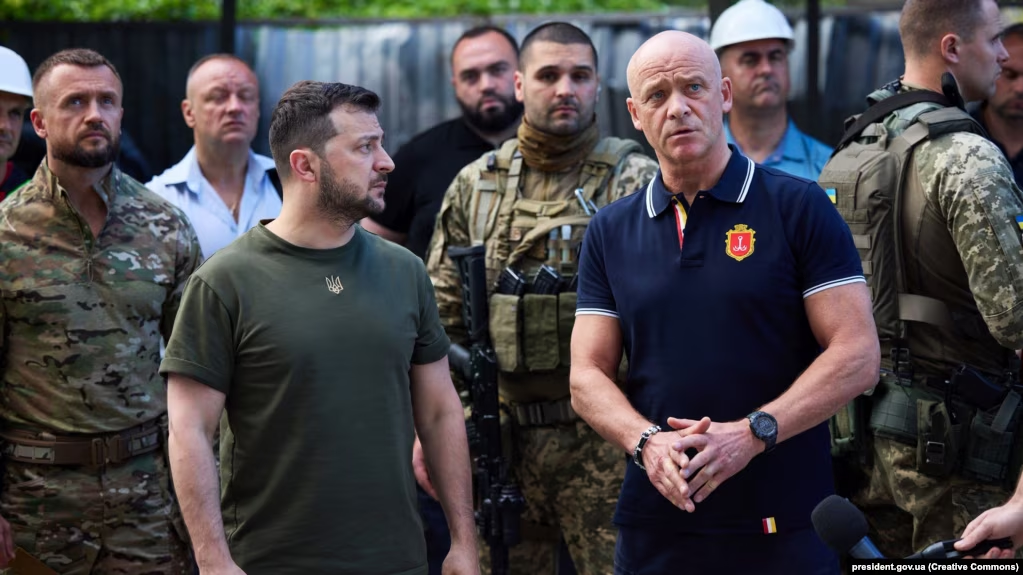
Ukrainian President Volodymyr Zelenskyy signed a decree on October 14 revoking the citizenship of Genadiy Trukhanov, Odesa’s elected mayor, removing him from a position he had held for 11 years. A day later, the city was placed under military administration.
The decision sparked a wave of allegations that the President is over-reaching, and claims he had been played by the Kremlin’s misinformation and destabilization networks.
The decision followed a statement by Ukraine’s Security Service (SSU) that it had discovered, following many years of heated speculation, that Trukhanov obtained Russian citizenship in 2015. The mayor rejected the claims and said he will file a lawsuit against the government.
Many found the SSU’s case unconvincing. Christo Grozev, founder of the investigative network Bellingcat, for example, claimed the document presented by the SSU was “demonstrably fake, and likely originates from a Russian active measure against the incumbent mayor.”
The Russian opposition investigative news site, The Insider, reported the document was issued in 2010 and not 2015, as the SSU had stated. But it also contradicted Trukhanov’s claim that, “I have never had a Russian passport,” revealing he had held two. Trukhanov has promised to fight the decision in the courts.
Others pointed out that in 2018, when Trukhanov was investigated by the Anti-Corruption Bureau, the security services checked claims about a Russian passport and found no evidence of its existence.
Odesa is not only strategically crucial — it is Ukraine’s major port city and critical for exports — but is also a place shaped by a complex and intriguing past. The port city has been home to more than a hundred ethnicities, which has given it a cosmopolitan identity and given rise to questions of the city’s loyalty throughout its history.
Before the full-scale invasion, Odesa was predominantly Russian-speaking, and even after the war began, it remained largely so. With distinct cultural and linguistic characteristics, its population fiercely supports its local identity and, despite being labeled “pro-Russian” by some, there has been no significant support for separatist projects.
Trukhanov was first elected in 2014 and has been reelected twice, despite several corruption scandals. His last victory, in 2020, was against a pro-Russian candidate, at which point he won more than double the number of votes won by the President’s Servant of the People party. Two years later, he denounced the full-scale invasion and has also campaigned abroad to raise money for the city’s military protection from Moscow’s air attacks.
At the same time, Trukhanov has been criticized by nationalists for not doing enough to de-Russify Odesa. They cite his opposition to the renaming of streets and removal of monuments, although this is a question that deeply divides opinion among city dwellers, a large share of whom argue that removing Russian street names is a denial of Odesa’s complex history.
Tukhanov’s disagreement with some government policies, especially on street names and monuments, has also created the impression he is an opponent of Zelenskyy and the military administration the president has imposed on the region.
The decision to revoke the mayor’s citizenship sparked major criticism of the President’s office from Odesans and even Trukhanov’s political opponents. Oleksiy Goncharenko, a lawmaker from the pro-Brussels European Solidarity Party and a rival for a decade, said he opposed the move.
“No matter how much some people may dislike it, the people of Odesa voted for Trukhanov,” Goncharenko said in a statement. “Besides, he was born in Odesa. Remove Trukhanov? Please, do so, but only by legal means.” Goncharenko said the case should be settled in court rather than imposed by the central government.
“Today they will take Trukhanov away, and we will all rejoice because he is bad, and tomorrow this machine of repression will be turned against inconvenient people,” the legislator said. He warned that Kyiv’s actions might signal the end of local self-government across Ukraine.
It is a fair concern. Odesa already had a regional military administration, and the establishment of another, with a commander loyal to the central government in place of an elected mayor, has raised alarm about the erosion of local democracy.
In 2022, Zelenskyy sparked controversy when he removed the mayor of Chernihiv, who had conflicts with the President’s office, in the midst of a corruption investigation. The decision in Odesa follows a series of other events that have led opponents to claim the government is determined to centralize power.
The fight against Russian influence and espionage, particularly in strategically important cities like Odesa, is crucial. And Trukhanov is very clearly an irritation to a central government focused on a war of national survival. But opponents of the decision point out that Ukraine is a democracy and that distinguishing it from Russian despotism is a core national value.
Locally elected administrations in Ukraine represent local communities and should be left to get on with their work unless and until it is shown they have failed.
Mykyta (Nikita) Vorobiov is a political analyst and a Master`s student at the University of Oxford, pursuing an MSc in Russian and Eastern European Studies. He holds a BA in Ethics and Politics from Bard College Berlin, where he conducted extensive research on Russian visual propaganda. For the last four years, Nikita has been publishing articles on politics and law for CEPA, VoxEurop, JURIST, and others.
Europe’s Edge is CEPA’s online journal covering critical topics on the foreign policy docket across Europe and North America. All opinions expressed on Europe’s Edge are those of the author alone and may not represent those of the institutions they represent or the Center for European Policy Analysis. CEPA maintains a strict intellectual independence policy across all its projects and publications.

War Without End: Deterring Russia’s Shadow War
Either Europe will continue allowing Russia’s shadow war to set the terms of escalation, or it will act now to prevent a larger war.

CEPA Forum 2025
Explore CEPA’s flagship event.


