
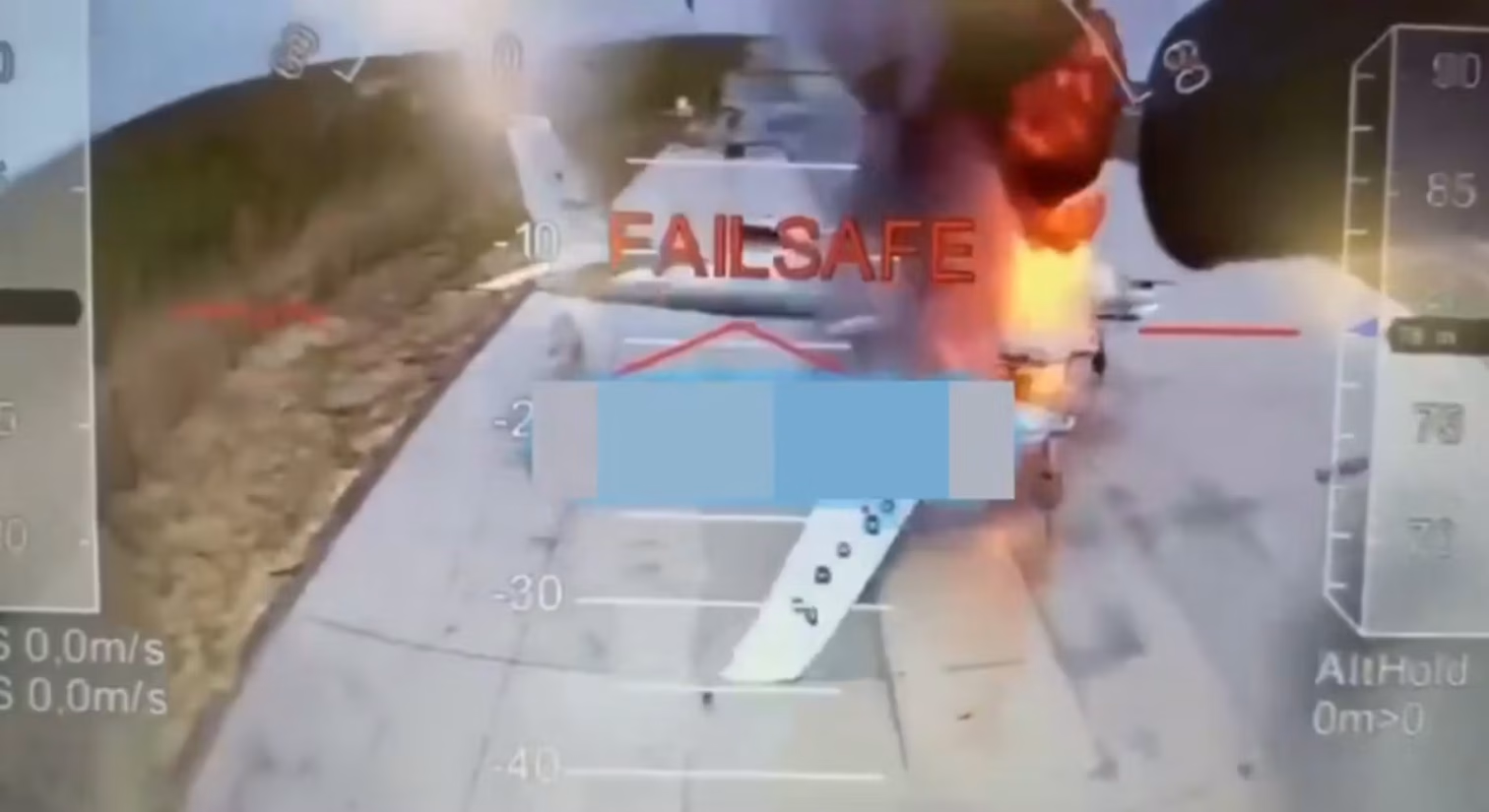
June 1 last year would have seemed a typical early summer day to the airmen at Olenya air base in northwestern Russia.
Situated not far from Finland, airfield personnel had little to worry about from the Ukrainian armed forces 1,100 miles to the south. Or so they thought, until a loud buzzing noise cut through the calm. A swarm of quadcopter drones emerged through the roofs of trucks parked nearby that had been loaded with explosives-carrying drones by Ukrainian intelligence. They descended upon the fleet of advanced aircraft at the base. At least four Tu-95 and Tu-22 bombers were later assessed as destroyed, and another four damaged.
As smoke billowed into the sky over Olenya, Ukraine’s Operation Spiderweb also struck three more key air bases throughout Russia: Dyagilevo in Ryazan Oblast, Ivanovo in Ivanovo Oblast, and Belaya in Irkutsk Oblast. Estimates suggest at least 12 aircraft were destroyed and three damaged, though the numbers may have been higher.
Ukrainians were exultant. They had reached deep into Vladimir Putin’s state and hit missile-firing aircraft that had been tormenting their country for many long months. But while Western military figures and analysts shared the feel-good moment, they were also aware of something else: allied air forces and critical infrastructure were equally vulnerable.
Quite how far the lessons have been learned is questionable. As the Iran war has shown, US tankers and airborne early warning aircraft have fallen victim to attacks in recent months. Like the Russian aircraft, they were parked in the open. Ground defenses failed.
For Ukraine, the attacks heralded a new campaign of medium- and long-range drone and missile attacks. These have enormously expanded in the past 12 months, and especially this year. One estimate suggests Ukraine launched more than 2,000 missiles and drones against Russia in April alone, a record.
For Ukraine, these tactics are a part of a much broader strategy. Although the purpose of Spiderweb was to destroy Russia’s strategic bombers, it also sought to force Russia to push its operational focus further from the frontline, with some success. Other Ukrainian attacks have been much broader, targeting Russian oil infrastructure, which is a key financial support for the Putin regime. The effects of the campaign are becoming clear; Russian business associations are seeking the ability to buy their own air defense systems (mirroring a right granted to Ukrainian businesses).
Tactically, operations like Spiderweb are a must for Ukraine to stay in the fight. Beyond their military value, they demonstrate resolve and audacity to the domestic and foreign audience. More than four years into the war, Ukraine still lacks the manpower to push Russia out of its territory and stop it from launching severe strikes on its energy infrastructure to threaten the civilian population in the depths of winter. It is critical to the war effort to show that the country can strike back.
The resources required for Spiderweb are not easily replicable. The manpower, planning, and spycraft took more than a year to execute from start to finish. Russia is better prepared. Smaller-scale attacks, however, are possible and easily scaled up.
All of which underlines the need for Western militaries to understand that they face the same threat. What would stop Russia from engaging in intensive aerial bombardments in Poland or Estonia? Both countries are aware of the threat (and possibly better prepared than allies more distant from Russia).
As a part of its ongoing fight against the US and its partners, an Iranian Shahed drone, likely launched from Lebanon, struck the RAF base at Akrotiri in Cyprus. The explosion left a large hole in the hangar where US U2 spyplanes are housed. The attack underscored how little the West seems to have learned from the war between Ukraine and Russia.
Worryingly, Cypriot hotels and airlines reported mass cancellations. If a single drone can make its way inside to an RAF hangar many miles from the intensive fire zone and cause a mass panic, imagine the havoc Russia could wreak among European civilians in a full-scale war.
More recently, Russia has been using electronic warfare capabilities to redirect Ukrainian drones into NATO territory. Drone incursions in Latvia led to a government reshuffling only two weeks ago. Large airports in Europe, including Copenhagen and Munich, were closed by UAVs in several instances last year.
Operation Spiderweb proved that a patient adversary with modest resources and good intelligence can neutralize billion-dollar military assets. After a year, solutions to that lesson have not yet been agreed upon among the countries that most need to improve their defenses.
Henry Patton is Special Assistant to the Vice President at CEPA. A graduate of Northwestern University, his research focuses include international law, Russian and Chinese malign influence in Europe, criminal justice in the Soviet Union, and critical minerals supply.
Noah Greene is the senior program officer for the Transatlantic Defense and Security Program at the Center for European Policy Analysis (CEPA), where he facilitates the research and programmatic functions of the team. His portfolio covers the entire European continent and the full range of functional topics related to defense. He regularly speaks and publishes on topics including NATO institutional dynamics, transatlantic defense strategy, military technology, and emerging security challenges.
Europe’s Edge is CEPA’s online journal covering critical topics on the foreign policy docket across Europe and North America. All opinions expressed on Europe’s Edge are those of the author alone and may not represent those of the institutions they represent or the Center for European Policy Analysis. CEPA maintains a strict intellectual independence policy across all its projects and publications.


