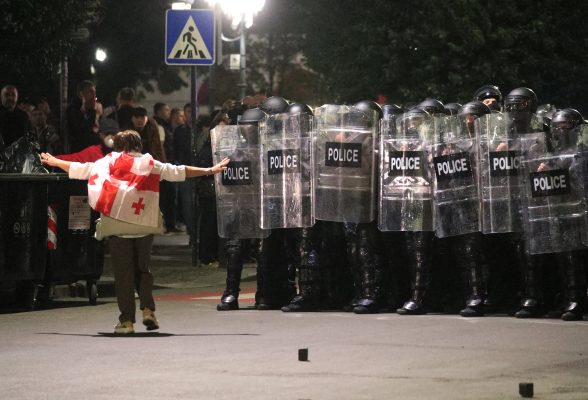
There are signs of serious strains within the Georgian state as the ruling party pursues its campaign of repression. This indicates trouble, though it’s not yet a signal of collapse.
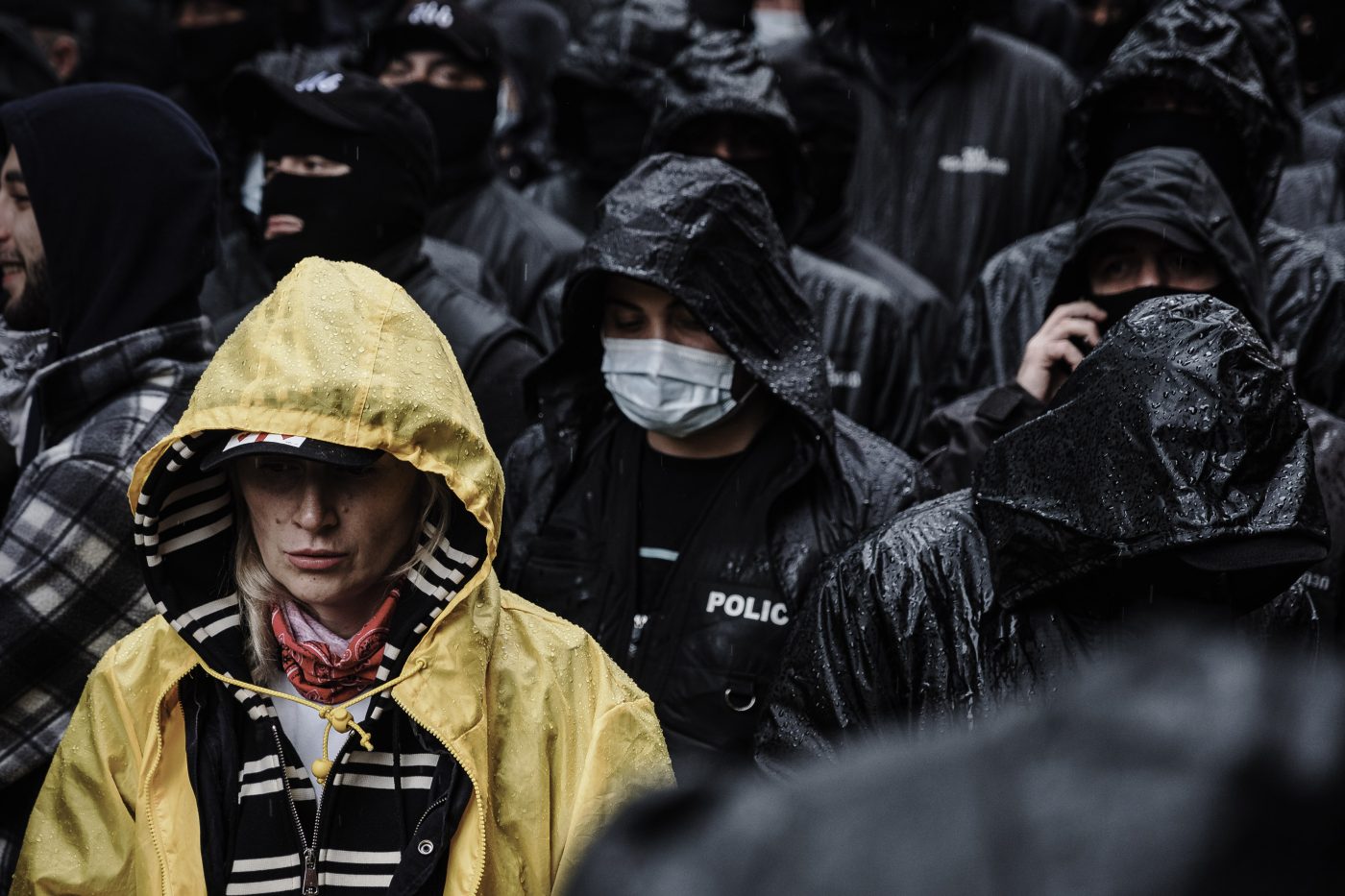
Police officers, who are on the front lines of the often violent campaign against protesters, are quitting in unprecedented numbers. About 100 officers have had applications to resign rejected by the Interior Minister, according to former Prime Minister and Interior Minister Giorgi Gakharia. Several hundred others have meanwhile refused to obey orders to disperse demonstrators and have left their jobs, Georgian media report.
The size of protests has decreased since the initial mass demonstrations after the government made known on November 28 that it was suspending talks on European Union (EU) membership talks for at least four years. But the anti-government rallies continue every night and opinion polls show they have the support of 65% of the population (especially young people.)
And the ruling Georgian Dream party is very clearly worried that it cannot crush the upsurge of public dissent, something made harder by the departure of so many officers. The shortage of pro-government security forces has been met so far by using unofficial groups and private security companies to police protests, and attack and arrest citizens. The shortage of people willing to do the government’s bidding became still more obvious when it was announced that from January 1, the Interior Minister wants the right to hire new police personnel without the need to meet existing competition and other mandatory rules.
In addition, the authorities have hastily increased funding for the police for the current year by 20m Georgian Lari ($7m), along with a substantial rise for next year. Lacking a sufficiently obedient police service, it seems the government has decided to build a new one.
It may now be trying to do the same with the opposition. Before the October elections, the country’s unofficial leader, the billionaire Bidzina Ivanishvili, promised supporters that after the elections, what he called a new and constructive opposition would emerge.
He has kept his word. With the true opposition parties boycotting parliament over what they say was widespread vote-rigging, on December 13 a number of Georgian Dream deputies declared that they would now undertake the role. Moreover, on the same day, a deputy from this artificially created “opposition” group, a man named Sozar Subari, was elected as deputy chairman of parliament from the opposition quota.
It is noteworthy that this group of deputies had already played the role of quasi-opposition in the previous parliament when they created the pro-Russian People’s Power in 2022, although on the eve of the parliamentary elections, they again merged into the Georgian Dream.
People’s Power has a broader role to play. Since December 14, its representative, a former English Premier League soccer player called Mikheil Kavelashvili, was elected President by a new electoral college.
The existing President, Salome Zurabichvili, who was directly elected, called the vote a “parody” and refused to recognize the outcome or the legitimacy of the new parliament. According to the Constitution, the President is the head of state and is the guarantor of the country’s unity and national independence, the Commander-in-Chief of the Defense Forces and represents the country in foreign relations.
Kavelashvili, an ex-MP who played for Manchester City and various Russian clubs, was the only candidate and received every single valid vote cast. European politicians have already called the new sixth president of Georgia “ultra-right” and pro-Russian. The Russian media has rejoiced with headlines such as: “Russian football champion becomes president of Georgia.”
The new head of state, born in 1971 does not have a higher education at all, something that barred him from running to become head of the Georgian Football Federation. In response to public criticism over the president’s lack of advanced educational qualifications, the leaders of Georgian Dream responded that: “To love the homeland, a higher education diploma is not necessary.” During his time as an MP, Kavelashvili was known for making obscene remarks about opponents at parliamentary sessions and for his pro-Russian and ultra-conservative statements.
In 2012, when Georgian Dream was preparing for power, Ivanishvili promised that: “In Georgia will be the kind of democracy that will surprise all of Europe.”
Some 12 years later, Georgia is becoming a police state, isolated from Europe and close to the Kremlin, headed by a president-footballer, with a puppet opposition in parliament and with an uncertain future.
Dr. Beka Chedia is a researcher and professor of political science from Tbilisi, Georgia. He is a Tbilisi-based country expert, political analyst, and contributor to several leading think tanks and research centers in Europe and the US.
Europe’s Edge is CEPA’s online journal covering critical topics on the foreign policy docket across Europe and North America. All opinions expressed on Europe’s Edge are those of the author alone and may not represent those of the institutions they represent or the Center for European Policy Analysis. CEPA maintains a strict intellectual independence policy across all its projects and publications.

War Without End
Russia’s Shadow Warfare

CEPA Forum 2025
Explore CEPA’s flagship event.