Georgia is in yet another crisis following the government’s contentious decision to delay its bid to join the European Union (EU.) The move has ignited protests across the country, where tensions its foreign policy direction have been simmering for months.
The opposition and significant parts of the population accuse the ruling Georgian Dream (GD) party of steering the country on an increasingly illiberal path, undermining aspirations for EU membership long cherished by many Georgians. The government’s abrupt announcement on November 28 that it was suspending EU accession talks until 2028 provoked widespread protests in Tbilisi and most other towns.
Salome Zourabichvili, Georgia’s staunchly anti-GD president, has condemned the government’s actions. “The violent suppression of protesters and media evokes the darkest memories of Russian repression,” she stated.
Her remarks echoed international criticism, with both the EU and the US denouncing the Georgian government’s handling of the crisis and expressing concern over Georgia’s democratic backsliding. The ruling party has argued that the situation on the ground is calm and that the protests are dealt in the most humane way possible. This despite hundreds of arrests and beatings by riot policemen and the arrests of opposition figures.
Georgia’s Prime Minister Irakli Kobakhidze justified the suspension, citing the European Parliament’s rejection of Georgia’s recent election results over alleged irregularities, accused the EU of attempting to “blackmail” Tbilisi, and declared Georgia’s refusal to accept EU budgetary grants for the next four years. The government also argued that the EU integration process has not been stopped, but that the government will simply abstain from initiating EU accession talks (a distinction without a difference, the opposition responds.)
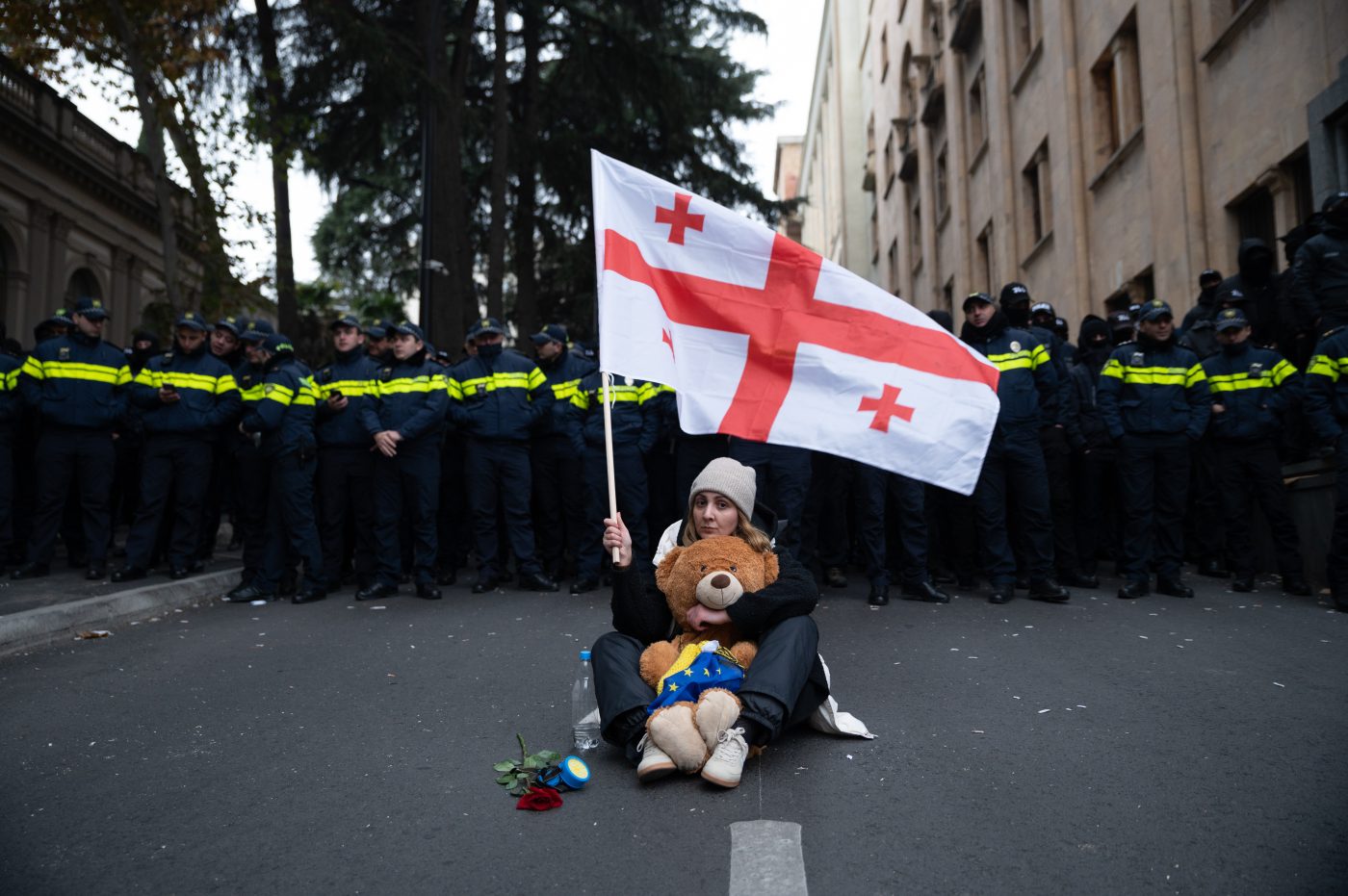
Huge crowds estimated at up to 200,000 in Tbilisi made clear their disbelief. On December 3-4, protesters flooded the streets for a seventh consecutive night, waving Georgian and EU flags.
So what’s new? After all, large-scale anti-government protests have become a feature of Georgian life.
For the first time, widespread and significant protests have spread beyond the capital to all major cities such as Khashuri, Poti, Rustavi, and most notably the Black Sea city of Batumi. This was not the case with previous protests, for example against the so-called “agents law” last year and this year, or even short-lived demonstrations following the contested October election results.
Moreover, the current protests are also not about opposition parties versus the ruling party but involve a much larger segment of the population which feels intimately attached to the idea of Georgia’s integration with the EU. Indeed, the constitution enshrines EU membership as a national goal.
The widespread suspicion now, in Georgia and the West, is that the government’s shift foreshadows closer ties with Russia which instigated separatism in the country in 1990s, invaded Georgia in 2008 and has long occupied 20% of its territory in Abkhazia and South Ossetia. Kremlin-aligned Russian journalists and bloggers christened the protests as another Maidan,a reference to the popular protests in Kyiv which led to the fall of the former Ukrainian president Viktor Yanukovych in 2013-2014 and the start of Russia’s invasion.
Vladimir Putin praised what he called the persistence of the Georgian government. Most recently, Kremlin spokesperson Dmitry Peskov denied interference but drew parallels to Maidan, while former Russian President Dmitry Medvedev criticized the Georgian president.
There are no signs that a compromise is close, and it’s now fair to say the country’s future hangs in the balance.
Georgia could return to its path toward EU membership, or double down on its pivot to Eurasia. The country makes its own decisions, but much will also depend on the EU and how skillful it will be in staying engaged. A great deal has been achieved in terms of reform, the rule of law, and bilateral relations with the EU, and much is at risk.
Emil Avdaliani is a professor of international relations at the European University in Tbilisi, Georgia, and a scholar of Silk Roads. He can be reached on Twitter/X at @emilavdaliani.
Europe’s Edge is CEPA’s online journal covering critical topics on the foreign policy docket across Europe and North America. All opinions expressed on Europe’s Edge are those of the author alone and may not represent those of the institutions they represent or the Center for European Policy Analysis. CEPA maintains a strict intellectual independence policy across all its projects and publications.

War Without End
Russia’s Shadow Warfare

CEPA Forum 2025
Explore CEPA’s flagship event.