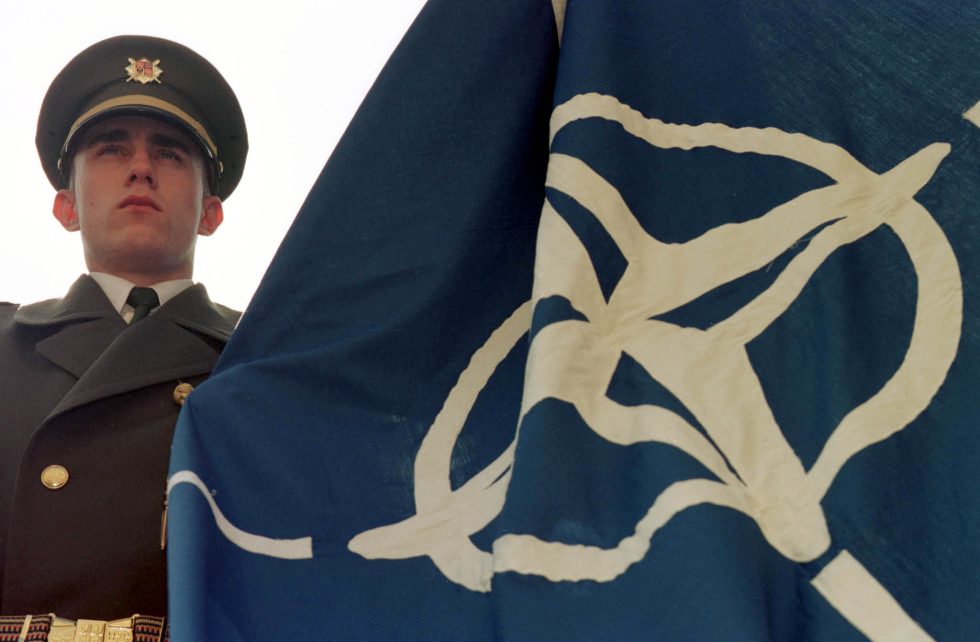
It is 1996 and I visit the base of a Czech mechanized battalion as part of a story to assess the army’s readiness for NATO entry, which finally takes place on March 12, 1999.
It does not start well. As I walk across the parade ground with the battalion adjutant, a grizzled major with a fabulous and fulsome white mustache, there comes the sound of cheering. We look up to see young, grinning conscripts who have hung a huge white sheet from their barracks. “We surrender,” they shout.
The scene comes as no surprise to contacts at NATO Headquarters. I am briefed by an official on the likely new members — the Czech Republic, Poland and Hungary. Their militaries are, he says, in a dire state. Outdated equipment, a Soviet-era mindset among the officers, a demotivated rank and file, and no money. Yes, they can field capable special forces units and perhaps a handful of halfway decent infantry units, but that’s it. Overall, they are hopeless.
So why did NATO expand at all? It would have been far easier to send training missions and other support. Perhaps a few second-hand planes and some old, armored vehicles.
The reasoning (thankfully) was strategic and historic. For generations, the peoples of Central Europe had been the meat in the sandwich, pressed between Germany to the west and Russia to the east. Nibbled at, or eaten whole, they had a traumatic history; think Groundhog Day with goose-steps.
The collapse of the Soviet empire in 1989 was greeted as one of the great moments of 20th-century history (as it was), but how to keep the newly freed states safe? How to avoid a repetition of the region’s interwar descent into authoritarianism and its ultimate sacrifice to its big and splenetic next-door neighbors? Things get dirty, and quickly, in cordon sanitaires, as the 1930s showed.
Throughout the post-1989 period, it was often the father of the Velvet Revolution, the Czech President Vaclav Havel, who found the words to describe the problem.
Speaking at the Prague 2002 NATO summit, he explained it like this.
“If the past centuries witnessed various great powers dividing the small, or smaller, European countries among themselves without asking the latter’s opinion — whether this happened in direct forms such as the Ribbentrop-Molotov pact or indirectly through arrangements such as those at Yalta — the present enlargement of NATO carries an unequivocal message that the era of such divisions is over, once and for all.
“Europe is no longer, and must never again be, divided over the heads of its people and against their will into any spheres of interest or influence,” he said.
It must be remembered that in both this and future enlargements, the pressure did not come from the West, which was driven by uncertainty (sound familiar?)
It came from the countries themselves. If you were Czech, with memories of the Nazis arriving in 1938 and the Russians and their sidekicks in 1945 and 1968, then the “return to Europe” — that great slogan of the age — really meant NATO first and everything else second.
European Union (EU) membership mattered, a lot, but that would make no difference if one day the Russians decided to return.
It is now 25 years since the first three Central European nations joined NATO. Later joined by the Baltic states, Slovakia, Romania, Bulgaria, and the Nordic duo, the alliance has doubled in size from 16 Cold War members to 32.
And what of them? What do they add?
Well, quite a lot. It’s fair to say the three new members were in a poor state at the end of the 20th century, but it wouldn’t be now.
Take the Czechs. It is a country probably overly influenced by a collective enjoyment of that worst of all soldiers, The Good Soldier Švejk by Jaroslav Hašek (an anarchist by the way) and by the amused indifference of the men in Josef Škvorecký’s The Tank Battalion.
Czechs sometimes forget their extraordinary military history, starting with the ferocious, all-conquering, one-eyed (and later completely blind) medieval general, Jan Žižka, who scattered Catholic armies with admirable regularity. The story of the fearsome Czech regiments of the Habsburg period and the epic tale of the Czechoslovak Legion’s escape to freedom in the teeth of Soviet Red Army opposition during World War I are too rarely told.
And yet, the country has proved itself a solid ally in recent decades. Czech troops fought in Afghanistan and served in Bosnia, and the army now leads the NATO battlegroup in Slovakia (itself a signal of extraordinary reconciliation with its old Czechoslovak stable mate), while the country is led by a decorated war hero, President Petr Pavel, who was latterly the leader of NATO’s Military Committee.
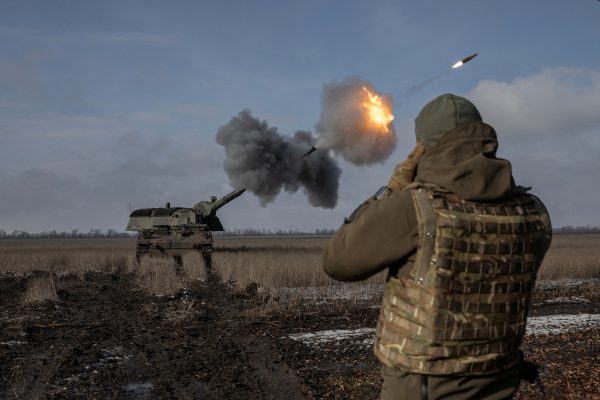
The recent Czech initiative to buy 800,000 artillery shells for the Ukrainian army from outside Europe has said something even more impressive; that when bigger powers are squabbling and too focused on themselves, the Czechs keep their eye on the ball. The jointly funded project is a testament to the work of a government and a president who understands the stakes.
The conscripts who entertained me at that dreary Bohemian barracks 28 years ago are middle-aged men now. Their sons and daughters only serve in the 28,000-person armed forces if they choose to, because the force is all-volunteer.
NATO has delivered the security that has helped secure the extraordinary success of the post-1993 Czech Republic. And the Czech people, along with the people of the other new members, have made the rest of us safer in return.
Francis Harris is CEPA’s Managing Editor. He was formerly Central Europe Correspondent, Washington Correspondent, and Deputy Foreign Editor for the Daily Telegraph.
Europe’s Edge is CEPA’s online journal covering critical topics on the foreign policy docket across Europe and North America. All opinions expressed on Europe’s Edge are those of the author alone and may not represent those of the institutions they represent or the Center for European Policy Analysis. CEPA maintains a strict intellectual independence policy across all its projects and publications.

War Without End
Russia’s Shadow Warfare

CEPA Forum 2025
Explore CEPA’s flagship event.